


VIENNA: A headscarf ban for girls under 14 in Austrian schools has stirred unease, anger and fears of further targeting of Muslims in the EU member state.
Austrian lawmakers in December approved the measure, which is set to take effect from the new school year in September.
With anti-immigration sentiment running high, the conservative-led government argues the law is aimed at protecting girls from “oppression”.
But rights groups and experts say it is discriminatory, risks deepening social division and is likely unconstitutional.
“It’s my decision… No one can force me to wear a headscarf, and no one can force me to take it off,” a 12-year-old student told AFP at a protest against the ban in Vienna last month, declining to give her name.
‘Legal consequences’
The government estimates around 12,000 girls would be affected by the new law, but this projection has been questioned as too high.
Roughly 8% of Austria’s nine million residents are Muslim, according to 2021 government statistics.
The education ministry sent out information to all schools several weeks ago on how to enforce the new law.
It contains illustrations of different Islamic head coverings.
“Every teacher who observes a violation must instruct the student to remove her headscarf. If she does not immediately comply, the teacher must report the violation to the school administration without delay,” the instructions state.
“The school administration must immediately hold a meeting with the student and her legal guardians.”
For repeated non-compliance, parents can face fines ranging from 150 to 800 euros ($175 to $930).
Failure to report those in violation of the law could also have “legal consequences” for teachers and school managements, the instructions warn.
One Vienna schoolteacher, who spoke on condition of anonymity, told AFP she was not planning to enforce the law.
“It’s a populist measure” that fails to address “the real problem when parents of any religion use violence or psychological violence against children,” she said.
‘Deeply rooted racism’
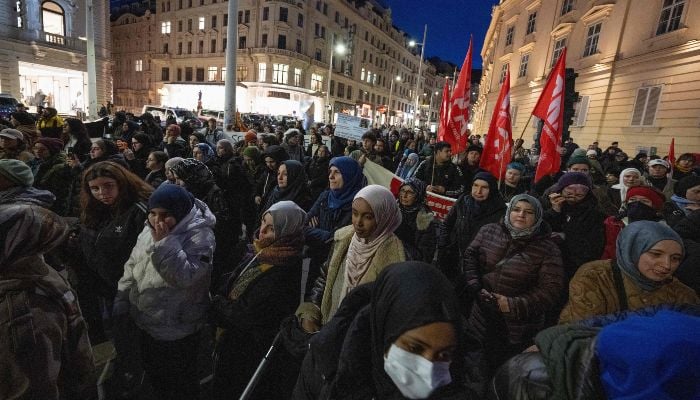
Last month, hundreds gathered at a central Vienna square to protest the ban before marching to the chancellery.
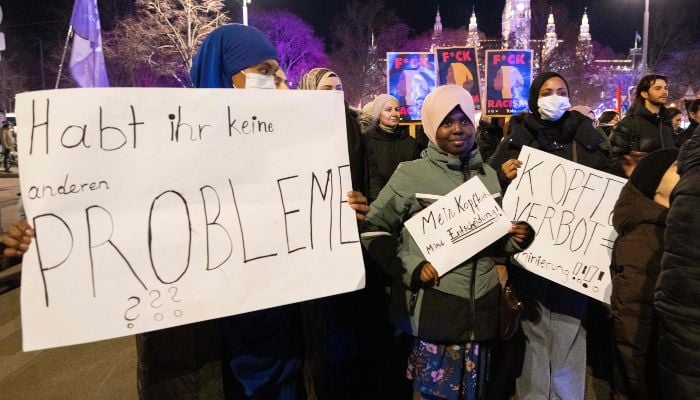
Malika Mataeva, co-founder of the Muslim Women Network, decried “years of systematic, deeply rooted racism in Austria.”
“It’s simply another step that makes us say, ‘Enough is enough,'” she told AFP, adding “guaranteed freedoms” were not being respected.
Austria has long drawn immigrants, as well as asylum seekers fleeing conflict. But anti-immigration sentiment is strong.
In the 2024 elections, the far-right Freedom Party won for the first time even though it failed to form a government.
Muslims in Austria suffered the highest rates of racism and discrimination in the EU, according to a 2024 report by Europe’s FRA rights agency.
Past ban struck down
The IGGOe, the body which officially represents the country’s Muslim communities, is set to challenge the ban in court.
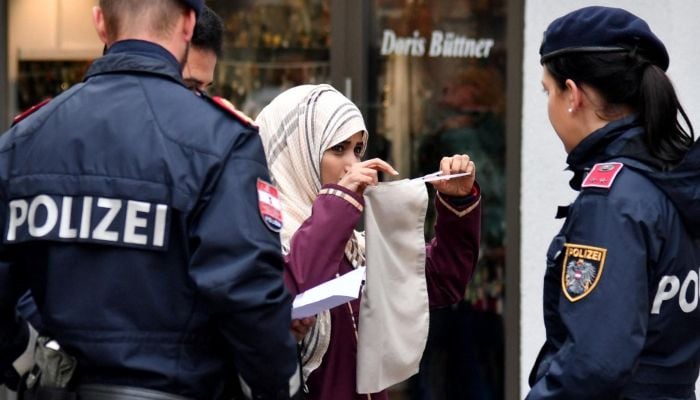
Austria introduced a similar ban on headscarves in primary schools in 2019, but the constitutional court struck it down.
“It is clear that we consider this law… to be unconstitutional in Austria, given its focus on a specific religious item of clothing,” the Ombud for Equal Treatment told AFP.
At the Vienna protest, an 11-year-old, who only gave her name as Hadiya, said she is the only student in her class of 27 who wears a headscarf.
“I’m angry…. I find it (the ban) is without reason,” she said.
A mother of two girls, aged 11 and 13, also said the ban has weighed heavily on her family, with her daughters not wanting to take off their headscarves.
“It’s supposed to be for their protection, but they’ve been suffering for months now and are worried about what to do,” she told AFP at the protest.


