


In 2025, an Ontario family’s routine farm cleanup exposed a strange stone that pointed to 12,500-year-old ice age hunters | – The Times of India


Cleaning up a family farm in Ontario unexpectedly resulted in an interesting discovery. While removing stones and other debris from the field, the family spotted some pieces of flint in the soil. Initially, the pieces looked ordinary. However, one piece caught their attention. It was clear that the piece was not just a simple rock. Rather, it was a part of some carefully crafted tool.This fragment was later identified as a fluted spearhead, a specific stone point associated with early humans living in North America. Based on the archaeological evidence provided by the National Library of Medicine, the presence of fluted points indicates the Paleoindian technology used in the Terminal Pleistocene epoch. Thus, this artefact could be dated back 12,500 years ago, which is a valuable finding.Characteristics of Fluted PointsFluted spearheads are not ordinary objects. The manufacturing of a fluted point requires skills and foresight. It is prepared by removing a long, thin flake from the base of the tool. The process creates a groove, which is instrumental in securing the point onto a spear shaft.Specialists note that this technique demonstrates highly developed skills. Fluting is one of the most unique technological attributes of ancient North American artefact makers, as per resources from the University of Alabama Museums.This method was not used solely for aesthetics. Rather, the tool was exceptionally functional for hunting.A partial piece is sufficient for identifying these characteristics. Archaeologists commonly use material composition, form, and flaking methods to recognise such objects. Scientific research in archaeological publications shows that stone pieces can retain certain diagnostic properties that connect them to primitive tool-making cultures.Glimpse into ancient CanadaThe age of this spearhead corresponds to an important period in human history. It dates back to about 12,500 years ago, when Canada had just recovered from the last Ice Age. Fluted points are often linked to this era of migration and adaptation.Research published in the National Library of Medicine reveals that early people employed these items while migrating through North America, hunting animals, and adapting to their surroundings.This gives great importance to the discovery of the artefact in Ontario. It demonstrates that early hunters existed in the area at a time when the environment was vastly different from what it is now. The current farmland was once a cold and shifting landscape shaped by glaciers and meltwater.
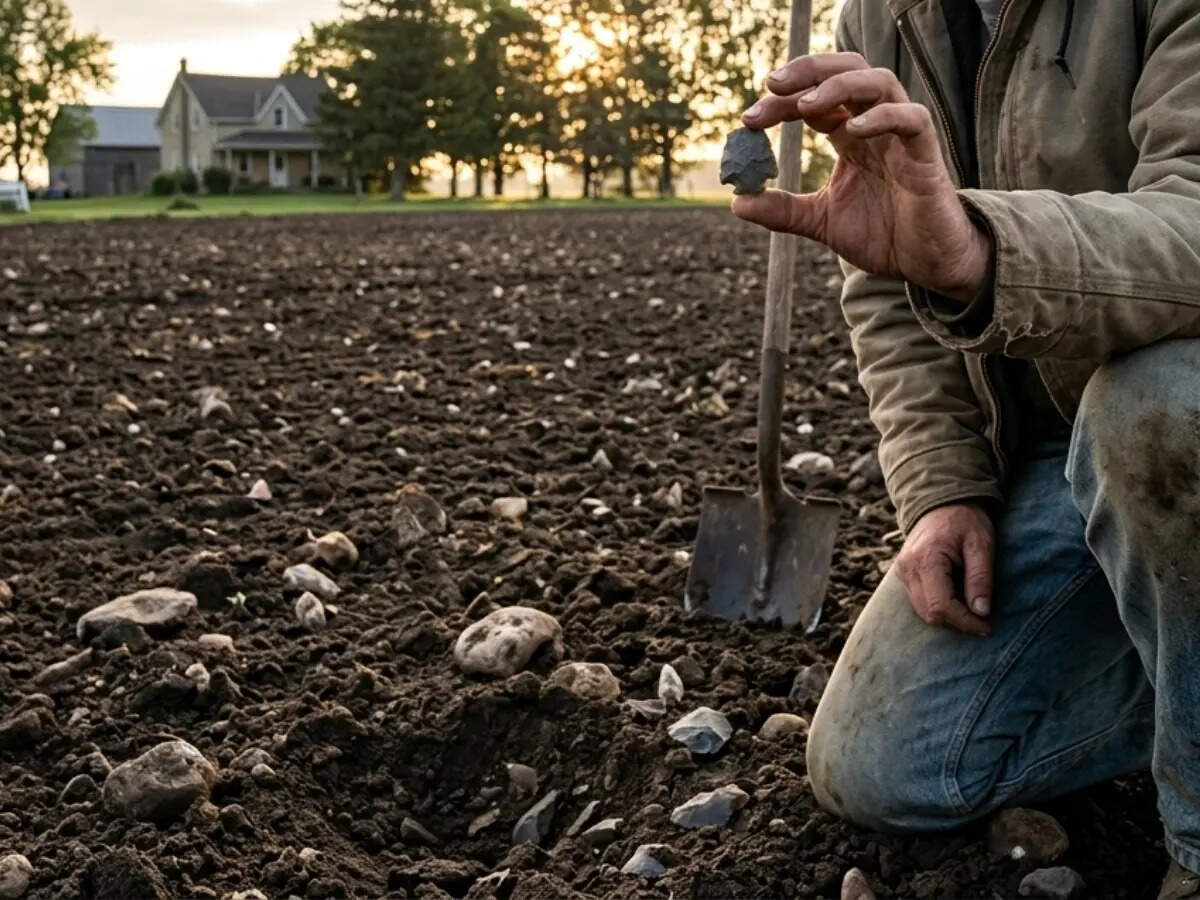
Ontario family found a rare Paleoindian spearhead. Image credit – Gemini
Significance of the fluted spearheadsFrom a superficial examination point of view, the found artefact may appear insignificant. It is just a piece of a spearhead rather than an entire one. Nonetheless, in archaeology, tiny artefacts can be quite meaningful.Stone weapons are the oldest artefacts left behind by early man. Stone lasts much longer than other materials, such as wood or bone. Thus, it provides insight into prehistoric cultures long after their extinction.The Ontario fluted spearhead belongs to a familiar type of ancient artefact. The design of the item, together with other evidence such as flint chips, proves that manufacturing and use of the artefact once took place in or around the site where it was found.Why context is so importantEven though the finding itself is important, there is still a need for caution because one artefact is not enough for an entire story. In archaeology, context, which involves the soil, location, and related items, plays a crucial role in making discoveries.Since the field has been cultivated for some time now, some of this context might have been lost. Nevertheless, it still makes sense to identify the piece of stone as a Paleoindian artefact since the material, the form, and the age are all right.In any case, as research has already proved, isolated discoveries can contribute significantly to mapping the ancient human habitation areas.Uncommon traces of human presence in prehistoric timesThe Ontario spearhead fragment is not just an ancient object; it represents an example of Palaeolithic ingenuity. It links the modern-day farm to the era of primitive men who used well-crafted tools to survive under tough conditions.The appeal of this tale stems from its beginning. There was no excavation or exploration process involved. It was all about a simple job and an astute observation. A few flint stones uncovered a story dating back over 12,000 years ago.As most archaeologists will tell you, history does not lie deeply hidden away in distant places. Sometimes it hides right under our noses.


