


2026 NBA offseason trade grades: Pistons deal Isaiah Stewart to Grizzlies


The NBA offseason is here, with Aaron Wiggins‘ trade to the Atlanta Hawks the first move of what should be a frenzied next month. The Oklahoma City Thunder are getting back two second-round picks in the deal for Wiggins, as the trade significantly decreases the Thunder’s tax bill. But the big news came late Monday night, when Giannis Antetokounmpo was traded by the Milwaukee Bucks to the Miami Heat in a blockbuster.
Will any other stars be dealt? I’m grading every trade this offseason, including draft deals, breaking down the ramifications for all teams and players involved.
To determine each grade, I’m looking at multiple factors, including the on-court impact and ages of involved players, the cost in terms of draft picks and future financial implications, and the context of the team’s short- and long-term outlooks. How risky or certain is the move? And how much does it help or hurt the team’s chance to win the championship, next season or beyond?
Let’s get into the latest moves:
Quick links:
Latest buzz | FA signing grades | Trade machine
Depth charts | Offseason guides | Draft coverage



Memphis Grizzlies get: Isaiah Stewart
Detroit Pistons get: Three second-round picks
Grade for Memphis: B+
What this means for Grizzlies: Spiritually, Stewart might have always been destined to become a Grizzly. Few players in the current NBA embody the “grit ‘n’ grind” ethos more than the 25-year-old, who has never been afraid to get physical on the court.
In addition to providing that toughness for a fanbase bound to appreciate it, Stewart will serve two key roles for his new team. First, he’s an elite rim protector: Stewart allowed opponents to shoot just 44% at the basket last season, per NBA Advanced Stats, which led all players with at least 100 shots defended. The previous season, he ranked second behind Chet Holmgren.
And second, Stewart will provide center insurance behind 7-foot-3 Zach Edey, who pairs immense potential with immense injury risk. Edey played just 11 games last season and has had multiple ankle surgeries in the past 12 months — an especially worrisome sign for a center of his size.
By the end of last season, with Edey and Santi Aldama injured and Jaren Jackson Jr. traded, the Grizzlies had effectively run out of big men and were playing entire games down the stretch without anyone taller than 6-foot-9.
Stewart himself is only 6-foot-8, but he plays bigger and operates mainly as a center. His 3-point shot has never fully developed (33% last season on 2.1 attempts per game), which makes it difficult for him to play with a non-shooting big. But next to Aldama or No. 3 pick Cameron Boozer — or even former Utah lottery pick Taylor Hendricks, who showed flashes last season after joining Memphis in the Jackson trade — Stewart would function as a perfectly competent backup center, or as a fill-in starter when Edey misses time.
Stewart will make $15 million in 2026-27 and has another $15 million via a team option for 2027-28. That eight-figure sum might be too much for Detroit to bear — more on that below — but Memphis has plenty of room to absorb Stewart’s salary while still retaining flexibility for other moves.
Given that the Grizzlies initially acquired three second-round picks from Detroit during the first round of the draft on Tuesday to move back from the No. 17 pick to No. 21, they effectively added Stewart in exchange for moving back four slots after the lottery. That’s good value for a team in their position.
Grade for Detroit: B
What this means for Pistons: Like with several other moves from contenders this month, the Pistons’ motivation to trade Stewart is primarily financial. The salaries for Detroit’s young core are growing more expensive: Cade Cunningham is now playing on a max extension, Jalen Duren is a restricted free agent this summer and Ausar Thompson is eligible for an extension.
Trading Stewart’s $15 million salary without taking back any money in return bumps Detroit’s room below the luxury tax to $75 million, according to ESPN’s Bobby Marks. The Pistons could also operate as a cap space team with a few additional maneuvers, such as shedding Duncan Robinson, who has only $2 million of his $16 million salary guaranteed.
So it’s almost unfair to give the Pistons a grade for this trade yet, as it’s clearly the first domino in a series of moves designed to give the 60-win team a better chance at advancing further than the conference semifinals next season. It remains to be seen how they use their extra wiggle room.
But the Pistons are aiming, above all, for more financial flexibility: to re-sign Duren (who almost has to return at this point, despite his playoff struggles, given that the Pistons traded his backup), re-sign Tobias Harris and add more firepower next to Cunningham.
And while Stewart matched Detroit’s ethos just as aptly as he will in Memphis, the Pistons might not miss him as much on the court. Analytics darling Paul Reed is overqualified as a third-string center — either he or Oklahoma City’s Jaylin Williams is the best third-stringer in the league — and is signed to a nonguaranteed $5.6 million deal for 2026-27. Promoting him to second string would save Detroit nearly $10 million in the tradeoff.
Ultimately, taken on its own, this trade makes the Pistons worse, as they lost a positive contributor without adding anyone in return. But Detroit’s front office deserves the benefit of the doubt — that it has a plan in mind for what more impactful domino should fall next.



Minnesota Timberwolves get: No. 33 pick (via Nets), Mouhamadou Gueye
Chicago Bulls get: Nic Claxton
Brooklyn Nets get: Julius Randle, No. 28 pick (via Timberwolves)
Grade for Minnesota: B
What this means for the Timberwolves: Two years after they acquired Randle and Donte DiVincenzo in exchange for Karl-Anthony Towns, Towns is an NBA champion while DiVincenzo is out with a torn Achilles and Randle is the subject of a salary dump. If it needed any further clarification, Minnesota definitely lost that blockbuster trade.
But focusing on how the Timberwolves landed Randle two years ago is a matter of the sunk cost fallacy, so let’s focus on the present. Minnesota’s side of this three-team trade is almost entirely motivated by finances. Randle is owed $33.3 million in 2026-27 and $35.8 million on a player option in 2027-28, as part of an extension he signed last summer.
By trading Randle in a deal involving the two teams with the most cap space in the league, the Timberwolves were able to shed that hefty salary without taking any guaranteed money back in return. They also had to drop just five spots in the draft to do so, even if the difference in “they traded a first-round pick for a second-round pick” overstates that gap.
The Timberwolves’ new financial situation places them $42 million below the luxury tax line and $50 million below the first apron. It also gives them access to multiple exceptions they can use to sign players this offseason, as well as a $33.3 million trade exception they could use for a highly paid veteran who fits their roster better.
Step one with all of that extra space was re-signing Ayo Dosunmu, an unrestricted free agent after a positive post-deadline stint with the Timberwolves. Further upgrades are sure to come thereafter, because without Randle or the injured DiVincenzo, the Timberwolves’ roster is still very incomplete.
Replacing Randle shouldn’t be an insurmountable challenge. His departure opens up a starting slot for sixth man extraordinaire Naz Reid, with whom Rudy Gobert has a proven partnership — the duo has a plus-9.1 net rating in more than 2,700 minutes together over the past three regular seasons, per databallr.
And while Randle averaged 20 points and 4.9 assists per game over two seasons in Minnesota, his notorious playoff struggles limited his team’s upside. For the Timberwolves to make a run at their first Finals berth — and to get past the Thunder and Spurs in the process — they couldn’t rely on Randle as their No. 2 option behind Anthony Edwards.
But the real problem is what happens once Reid moves to the starting lineup, because the Timberwolves were already relying on a tight playoff rotation, with little depth beyond their top seven or eight players. They’d better make good use of their extra money to round out a more supportive roster, because they’re now down two good players from last year’s group without adding any suitable replacements — yet.
Grade for Brooklyn: C+
What this means for the Nets: Welcome back to New York, Julius Randle. The three-time All-Star’s first stint in the city, with the Knicks, saw him play alongside a high-scoring veteran forward with trade value (Marcus Morris) and a bunch of young ball handlers (RJ Barrett, Immanuel Quickley, Frank Ntilikina and Dennis Smith Jr., among others), and he looks poised to repeat that experience, with Michael Porter Jr. as the forward with trade value and all of the Nets’ 2025 draftees as the young guards.
In a league that no longer rewards tanking as it once did, thanks to new lottery rules, Randle carries extra value as a floor-raiser — and the Nets, who don’t even control their 2027 first-round pick, had might as well try to win some more games next season after losing 50-plus in each of the last three seasons.
In that respect, Randle’s greatest ability is his availability. He has played in at least 69 games (or the equivalent in COVID-shortened seasons) in 10 of the past 11 seasons, ranking seventh in total games and eighth in total minutes in that span.
Randle’s steady 20 PPG production should boost the Nets’ 30th-ranked offense. And while he has never been the most efficient shooter, he’s an underrated passer, which could relieve some pressure from the overtaxed group of young guards who struggled last season.
It’s fair to wonder, though, what Randle’s acquisition amounts to for Brooklyn, which will end up cutting out a major chunk of its cap space this summer to add a player without much value — at least, on his current contract — throughout the league. The Nets are still unlikely to be a playoff team next season, barring further meaningful upgrades, and the 31-year-old Randle will likely be well past his prime by the time the Nets are ready to contend.
Moving up five spots in the draft doesn’t seem like a large enough difference to justify this trade on an opportunistic basis, either.
The Nets should be more interesting next season as a result of this trade. Randle and Porter form a fascinating forward combination. Day’Ron Sharpe deserves extra playing time, and should slot in as the Nets’ starting center with Claxton gone. Multiple first-round picks will join the five first-rounders who already played for Brooklyn last season.
But does this trade make the Nets better, over the long run? It’s hard to answer yes with much confidence.
Grade for Chicago: B-
What this means for the Bulls: Trading for Claxton is the first move of new executive vice president of basketball operations Bryson Graham’s tenure, and it makes use of the Bulls’ copious cap space to add an experienced center essentially for free. (Gueye played two games for Chicago last season, and is on a nonguaranteed deal for 2026-27.)
Claxton has two years left on a contract that declines year over year. He is owed $23.3 million in 2026-27 and $21.1 million in 2027-28, which ranks in the middle of the pack among starting centers. That fits Claxton’s status as a middle-of-the-pack center.
Or, at least the Bulls hope he’s still at that level. At his best, Claxton’s calling card is his defense, but his metrics on that end have declined precipitously over the last few seasons, as he’s largely toiled away in obscurity for an out-of-contention Nets squad.
Claxton averaged 2.5 blocks per game in 2022-23, when he received down-ballot Defensive Player of the Year votes. But he’s tallied fewer blocks in every season since, down to 1.1 per game last season. At the same time, Claxton has allowed a higher field goal percentage at the rim every year.
Opposing FG% at Rim Against Nicolas Claxton
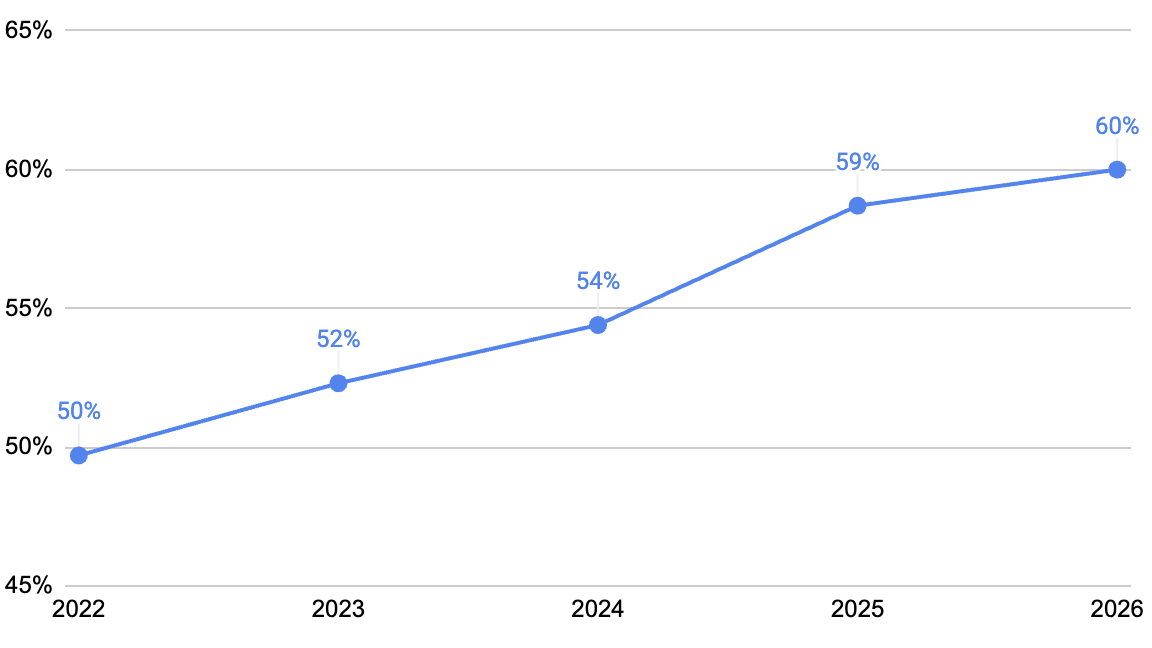
The Bulls’ hope is surely that Claxton felt the effects of not playing an important game for years on end, and that he can reverse his decline in a new environment. (Given the Bulls’ rebuild, however, it might be some time before Claxton plays an important game in Chicago, too.)
At 27 years old, Claxton is still theoretically in his prime, and he’ll have the runway to grow alongside 21-year-old forward Matas Buzelis and whoever the Bulls select with the No. 4 pick on Tuesday. If North Carolina forward Caleb Wilson lands in Chicago, as ESPN’s Jeremy Woo projects, then the Bulls would have a supersized, super-athletic frontcourt for their future — befitting Graham’s “SLAP” philosophy, emphasizing size, length, athleticism and physicality.
“SLAP” applies to Claxton, who has also been one of the NBA’s best switching bigs in previous years. But he’s a more limited player on the other end: He has never made more than five 3-pointers in a season, and he’s a career 56% free throw shooter. He’ll enjoy setting screens and rolling to the rim for Josh Giddey lobs, but likely not much else — though his 3.7 assists per game last season represented a major career high, and hint at untapped playmaking potential.
The larger question about Claxton in Chicago is whether the Bulls would have been better off using their cap space to trade for negative-value contracts and acquire extra draft picks in the process. They are also no longer a threat to offer a large contract to Jalen Duren or Walker Kessler — two younger, better centers than Claxton — in restricted free agency.
Claxton might have come essentially for free, in terms of assets, but his arrival still comes with a meaningful opportunity cost.
Still, the Bulls have $31 million in remaining cap space even after adding Claxton, which gives them enough flexibility to take on a bad contract and an associated pick if they desire. And they didn’t have any true centers on the roster after they traded Nikola Vucevic last season, so Claxton — ironically, a polar opposite player stylistically from Vucevic — fills a massive hole.
Taking on his contract into their cap space means it’s fair to treat the Bulls’ end of this three-team deal as if they were signing Claxton to a two-year, $44 million contract. That would be decent but not overwhelming value, and their grade here reflects that tradeoff.


Miami Heat get: F Giannis Antetokounmpo, F Bobby Portis
Milwaukee Bucks get: G Tyler Herro, C Kel’el Ware, F Jaime Jaquez Jr., G Kasparas Jakučionis , 2026 first-round pick (No. 13), 2031 first-round pick, 2033 first-round pick, 2030 pick swap, 2033 second-round pick
Grade for Miami: B-
What this means for the Heat: The Miami Heat have a reputation as a destination for the stars — but it has been quite a while since they actually landed one. The last time any Heat player finished higher than 10th in MVP voting was 2013-14, when LeBron James was the runner-up.
Since then, Miami’s biggest acquisitions are Jimmy Butler III and lower-level stars such as Goran Dragic, post-prime Kyle Lowry and Terry Rozier (the less said about that transaction, the better). The Heat were routinely in rumors surrounding superstars but didn’t turn those hypotheticals into reality.
That inability to close showed on the court. The Heat have reached 50 wins only once in 12 seasons since James left after the 2014 Finals, and they’ve been stuck in play-in territory four seasons in a row. Two Finals appearances in that span — including one marvelous run as the No. 8 seed — helped mask Miami’s mediocrity, but this is a team that has been searching for a higher level for a while.
Grade for Milwaukee: B+
What this means for the Bucks: Antetokounmpo’s departure closes the book on what is inarguably the greatest individual career in Milwaukee Bucks history. The former No. 15 pick is the franchise’s leader in almost every major statistic: games, minutes, points, rebounds, assists, blocks, field goals and free throws. He has 56 triple-doubles for Milwaukee; no other Buck is even in double digits. He’s a 10-time All-Star, two-time MVP and one-time Finals MVP, after scoring 50 points to close out the Bucks’ first title in 50 years.
But it was long past time for both him and the team to move on. After years of unfortunate injuries (Khris Middleton in 2022), ill-fated transactions (the Damian Lillard trade) and wasted drafts (the last Bucks pick to make a real impact for the team was Donte DiVincenzo, who was drafted eight years ago), the Bucks were no longer a legitimate contender, even with Antetokounmpo still receiving MVP votes.
Over the past four seasons, 15 teams won at least one first-round series. The Bucks weren’t one of them.
Read the full grade for the Antetokounmpo trade, plus league winners and losers.


Atlanta Hawks get: G Aaron Wiggins
Oklahoma City Thunder get: Two second-round picks (2030, 2032)
Grade for Atlanta: B+
What this means for the Hawks: Wiggins’ acquisition continues a solid start to the offseason for Atlanta, which first extended CJ McCollum on a low-risk deal over the weekend. Wiggins also comes with low risk: He’s on a good contract — $9 million in 2026-27, $8.2 million in 2027-28 and $8.2 million on a team option in 2028-29 — and the Hawks had to surrender only two far-off second-round picks to land him.
In Oklahoma City, Wiggins had fallen to the edges of the NBA’s deepest rotation, but he should have a much greater impact in Atlanta. The Hawks have a splendid starting lineup but were frightfully thin by the end of last season; in their six-game playoff loss to New York, Jonathan Kuminga was their only bench player to average more than five points per game or make more than eight total shots all series.
Wiggins can do better than that: He has averaged 17 points per 36 minutes over the past three seasons while making 39% of his 3-pointers. That scoring ability should make him one of the first players off Quin Snyder’s bench — though it does raise further questions about 2024 No. 1 pick Zaccharie Risacher‘s place in Atlanta’s rotation, if Wiggins earns more minutes on the wing.
The only factor dropping Atlanta’s grade on this deal from an A to a B+ is uncertainty around Wiggins’ true level. His numbers declined across the board in 2025-26 compared to the previous two seasons, most notably a true shooting percentage that was well above league average in 2023-24 (66%) and 2024-25 (60%) but fell below in 2025-26 (54%).
But even middling production would make Wiggins a relatively valuable contributor in Atlanta, given the inferior options he’s replacing.
Grade for Oklahoma City: B
What this means for the Thunder: Wiggins is a solid player, but he’d become a luxury in Oklahoma City, where he was the 12th or 13th man in the rotation. While he helped raise the Thunder’s floor in the regular season, serving as an effective fill-in when the players ahead of him were injured, he played just 75 minutes in the 2025-26 postseason.
When Wiggins received opportunities to prove he belonged in the Thunder’s conference finals clash against San Antonio, the Spurs played him off the floor.
Still, Oklahoma City’s decision to trade him is almost entirely motivated by finances, rather than his own play. In addition to removing the $9 million he’s owed next season from their books, the Thunder will save a projected $61 million in luxury tax penalties with this trade, according to ESPN’s Bobby Marks.
And because Wiggins is on an attractive contract, Thunder GM Sam Presti was able to acquire picks — even less valuable second-rounders — while shedding Wiggins’ salary, rather than including picks to entice another team to trade for him.
Expect additional moves of this nature as the offseason continues and Oklahoma City seeks to further reduce its exorbitant tax bill, which stands at a projected $152 million.


