


Govt jacks up petrol, diesel prices by over Rs13 per litre


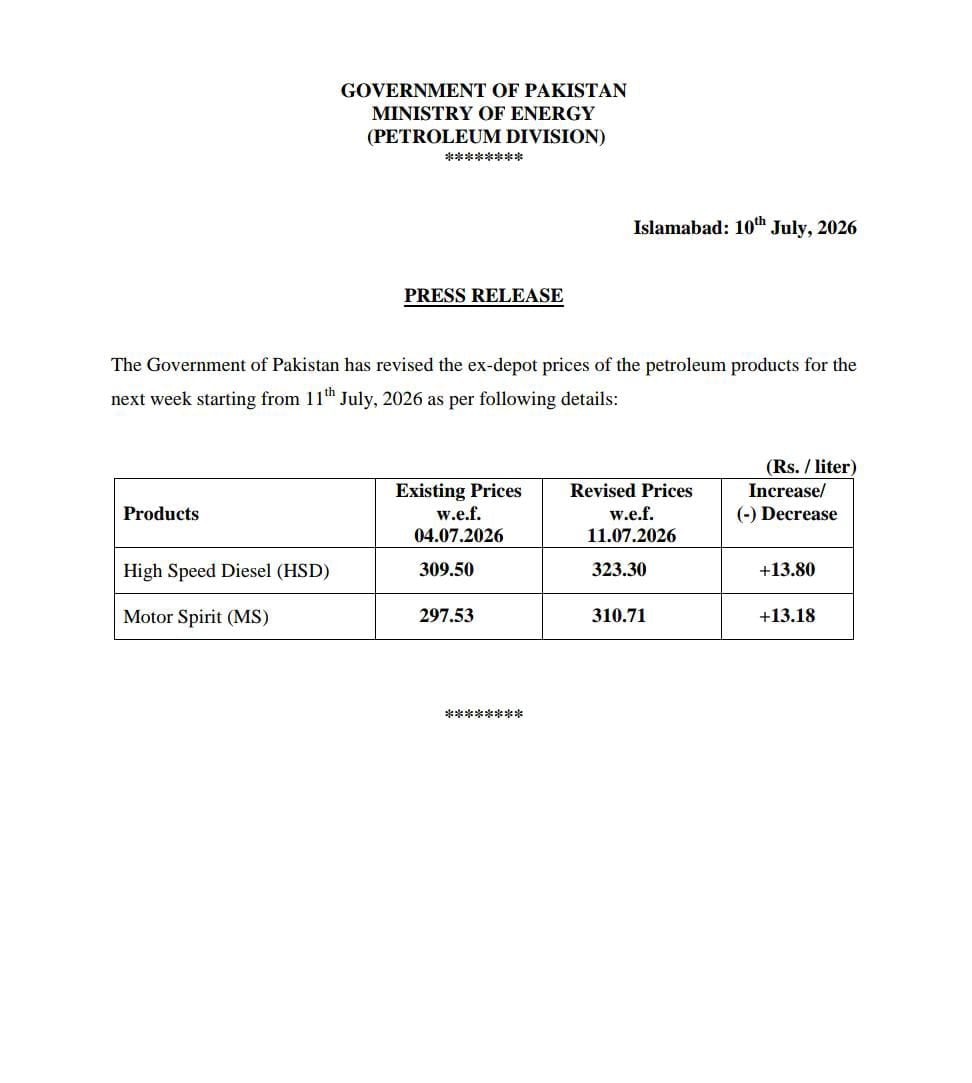
- New petrol price set at Rs310.71 per litre: Petroleum Division.
- Diesel rate increased to Rs323.30 per litre, says notification.
- Global oil prices fall on hopes for smoother shipping in Hormuz.
The government on Friday increased the prices of petrol and high-speed diesel (HSD) by Rs13.18 and Rs13.80 per litre, respectively, for the week starting July 11.
According to a notification issued by the Petroleum Division, new petrol and HSD prices have been set at Rs310.71 and Rs323.30 per litre, respectively.
The price of kerosene oil has also been increased by Rs11.19 per litre, according to a notification issued by the Oil and Gas Regulatory Authority (Ogra).
Following the increase, the new price of kerosene oil has been set at Rs242.33 per litre.
In the previous weekly review, the government reduced petrol and high-speed diesel prices by Rs1.97 per litre each.
Global Oil prices fell on Friday after the latest round of US-Iran fighting as traders grew hopeful that shipping would eventually resume in the Strait of Hormuz, but prices remained on track to close the week sharply higher.
Brent futures were down 52 cents, or 0.68%, at $75.78 a barrel by (1735 GMT). US West Texas Intermediate crude dropped 83 cents, or 1.15%, to $71.25.
Iranian armed forces launched attacks on US military infrastructure in Gulf states on Thursday after US strikes on Iran’s southern coastal and eastern provinces.
The developments have delayed a full reopening of the Strait of Hormuz, which carried about 20% of daily global oil and gas supplies before the start of the war on February 28.
The government has been reviewing petroleum prices on a weekly basis since the US-Israeli conflict with Iran on February 28.
Petrol is mainly used by commuters in small vehicles, rickshaws and two-wheelers. Higher fuel prices significantly impact the budgets of middle and lower-middle-class households, who rely on petrol for daily travel.
On the other hand, a significant portion of the transport sector relies on high-speed diesel.
Its price is considered inflationary since it is predominantly used in heavy goods transport vehicles, trucks, buses, trains, and agricultural machinery such as tractors, tube wells, and threshers.
The consumption of high-speed diesel particularly contributes to the increased prices of vegetables and other food items.
— With additional input from Reuters


