


Judd Apatow on comic genius Mel Brooks:


At the Golden Globes last week, Judd Apatow cracked up the room: “I’m very honored to be asked to present the award for best director, because I’m pretty sure that means the Globes people think I’m also one of the best directors.”
But Apatow is more at home behind the camera, as a director of comedies like “The 40 Year Old Virgin,” and of documentaries about some of his idols, like comedians Garry Shandling and George Carlin.
His latest subject hardly needs an introduction.
Asked why he decided to do a documentary about Mel Brooks, Apatow said, “Mel is the reason why most of us went into comedy. You know, when I was a kid (I was born in 1967), all these Mel Brooks movies came out while I was a little kid and trying to figure out what the world meant and who I was. And here was this hilarious, tiny Jewish man who was really loud and brash and confident, and seemed like the coolest guy in the world. And I think me and a lot of people thought, ‘Oh, that’s the job you would want. You would want to be Mel Brooks.'”
“Mel Brooks: The 99 Year Old Man” streams this week on HBO Max. Co-directed by Michael Bonfiglio, it’s the surprisingly personal origin story of a comedy legend – a Brooklyn kid raised by a single mom whose four sons went off to war.
In the documentary, Brooks described his wartime experience:
Brooks: “I was sent from a provincial tenement in Brooklyn to France, 1104th engineer combat battalion.”
Apatow: “And the Germans had just left France?”
Brooks: “Yeah.”
Apatow: “And so your job was to make sure they didn’t leave behind booby traps?”
Brooks” “Right. Forty-five degree angle with your bayonet, go through the soil, find, find, find, dink dink. Oh, oh!”
“I said to him, you know, “Did you ever think that you were gonna die?'” Apatow recalled. “And he goes, ‘Only every second of every day.'”
HBO Max 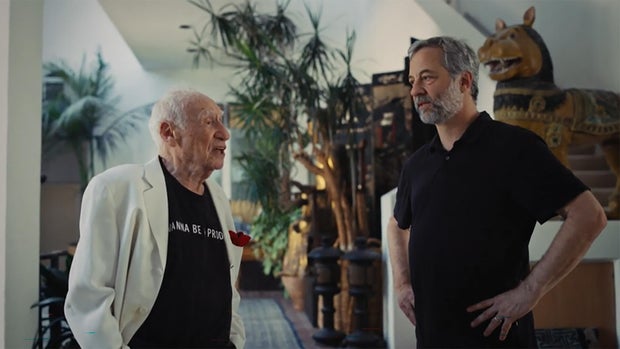
Brooks came home from the war, but he never really stopped fighting the Nazis – lampooning them in “The Producers,” “To Be or Not to Be,” and “History of the World Part I.”
Asked what made Nazis such a frequent target of Brooks, Apatow said, “The fear that it was gonna happen again. And then if you don’t keep pointing out how horrifying this is, then it can, you know, slowly bubble back up, which is something we see right now.”
And Brooks was equally fearless against racism. His 1974 film “Blazing Saddles” is the story of a Black sheriff in a racist town. Critics were divided over the raunchy comedy, but it was a monster hit with moviegoers. And just a few months later, he came out with another monster hit, “Young Frankenstein.”
What did releasing two big hits in the same year do for Brooks’ status? “He just became Beyoncé for a little while,” Apatow said. “I mean, he was a real sensation. And it was kind of shocking, right, that two of the best comedies of all time come out in the same year. And we didn’t talk about this in the documentary, but there was some sense that ‘Blazing Saddles’ was so daring that maybe he made sure to make another movie, so that if they really turned on him with ‘Blazing Saddles,’ he already had another one to show ’em.”
It wasn’t all just for laughs: Mel Brooks also produced dramas, like David Lynch’s “The Elephant Man,” but he did it quietly, refusing to put his name on it. “He thought it was a distraction, and you would think the movie was silly ’cause his name was on it,” Apatow said. “But yet, it said Brooksfilms. So, I think people figured it out. I think he should put his name on there.”
No history of Mel Brooks’ life would be complete without a mention of his best friend, comedy giant Carl Reiner. “It’s one of the great friendships of all time, because they were friends for, I mean, 70 years? Maybe more?” Apatow said. “You know, some people are just magic together. They just fit. And they adored each other more than I’ve ever seen two people adore and respect each other. I asked him, you know, ‘What is the core of this?’ And he said, ‘He’s my father.'”
Reiner was actually only four years older, but Brooks looked up to him, and later in life, as widowers, they leaned on one another. [Brooks’ wife, Anne Bancroft, died in 2005; Estelle Reiner died in 2008.]
Apatow said the loss of Bancroft was very hard on Brooks: “He famously would go eat dinner and watch a movie with Carl Reiner at Carl Reiner’s house, and he did that for many, many years. And they supported each other. And that’s how both of them got through it. And then after Carl died, Mel would go to Carl’s house alone and eat dinner and watch a movie. And I asked him why. And he said, ‘Because it feels like he’s there in some way.'”
Brooks, who will turn 100 in June, has two Oscars, four Emmys, and the Broadway version of his hit movie “The Producers” has 12 Tonys – a record that still stands today. He also won three Grammys, giving him rare EGOT status.
What’s more, he’s lived long enough to see how his work endures, in his films, and in the countless comedians he inspired.
Asked what Brooks thought his legacy was, Apatow replied, “He said he thought he was put on this Earth to make people laugh, and he did that.”
“What do you think Mel Brooks’ legacy is?” I asked.
“The main one is probably the funniest person of all time, and the creator of some of the best films of all time, one of the great Broadway musicals of all time, who had the courage to make comedy, both about unimportant things and the most important things, and he did it longer than anybody,” Apatow said.
To watch a trailer for the documentary “Mel Brooks: The 99 Year Old Man!,” click on the video player below:
For more info:
Story produced by John D’Amelio. Editor: Steven Tyler.
See also:


