


Michael B. Jordan on


It’s not much of a stretch to say that Michael B. Jordan has fought his way to the top. His performances are often game-changing – as a boxing champ (in “Creed”), a Marvel superhero (in “Fantastic Four”), or a Marvel villain (in “Black Panther”).
But his latest film required a different kind of superpower: In Ryan Coogler’s “Sinners,” Jordan plays twin brothers, Stack and Smoke, who open a backwoods honkytonk in the segregated South.
When Coogler shared the idea of him playing two different characters, Jordan says his reaction was, “‘I’m a do what?’ I think it was a little bit of anxiety, I think. A little bit nerves. But then, equal amount of excitement.”
And it gets really exciting when vampires show up. “Sinners” is a horror film, but it’s also about history, and the power of family ties.
To play characters from the Jim Crow South, Jordan drew a bit from his own family history. Relatives on his mother’s side hail from Hope, Arkansas, but years ago moved to a segregated Black neighborhood in Los Angeles called Oakwood (a place that is now Venice Beach).
We visited the First Baptist Church of Venice, which was the center of their community, and one of the only remnants still standing. Jordan, who moved to New Jersey as a toddler, never went to this place of worship, but he says he can still feel the connection to his family’s past. “I grew up in church, you know, very spiritual family,” he said. “Churches were, like, safe havens – places of prayer and refuge … The history, I mean, you can feel the weight when you walk into a place like this.”
I asked, “Did shooting ‘Sinners’ make you think about your own family history more?”
“Big time,” he replied. “It definitely connected me back to my family’s history that I’ve always had a strong connection with, but it just kind of reframed it a bit.”
His own history is remarkable as well: Dad is a U.S. Marine veteran; mom is a former high school counselor; and Michael Bakari Jordan was a child model, then a child star. He was still in high school when he was cast in the landmark series “The Wire,” and a few years later in another landmark show, “Friday Night Lights.”
He said, “There’s nobody in my family that came from this, I guess, that looked at it as a potential career, you know? I think once I didn’t go to college and I decided to move to California and pursue acting full-time, there was, like, there was no turning back after that one.”
His film breakout came in 2013 in director Ryan Coogler’s drama “Fruitvale Station.”
FROM THE ARCHIVES: Michael B. Jordan, Ryan Coogler on “Fruitvale Station” (YouTube Video)
Jordan worked with Coogler again a few years later when he climbed into the ring for 2015’s “Creed,” a spin-off of the “Rocky” franchise – and, by the way, the first Rocky film where Sylvester Stallone didn’t have top billing.
Jordan said, “Doing ‘Creed,’ so many different levels. The first time I transform my body, you know, learned a skill that I continue to do today, you know?”
“You still box?” I asked.
“Yeah, it’s a part of me at this point,” he said.
CBS News 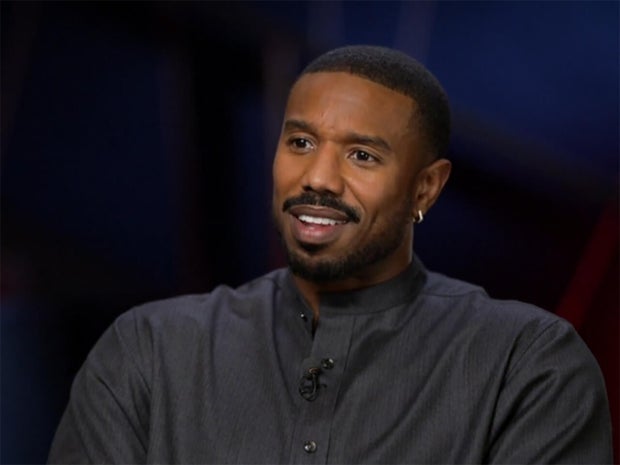
And this character of Erik Killmonger, the bad guy in “Black Panther” who tried to dethrone the hero played by the late Chadwick Boseman, stuck with him, too, but not in a good way. He says it was hard to shake Erik. “Yes, it kind of stuck with me for a bit. And, you know, went to therapy and talked about it. Found a way to kind of just decompress, I think at that point still learning that I needed to decompress from a character.”
“So, you literally went to therapy to help rid yourself a little bit of Erik?” I asked.
“Yeah. And then I think that spiraled into a bigger conversation and self-discovery of, like, ‘Okay, you know, I think that’s something that’s necessary for people, you know?’ Especially men. I think it’s good for them to go and talk. That’s something I’m not ashamed of at all, and very proud of. And definitely helped me trying to be a good communicator and a well-rounded person, inside and out.”
For Jordan, now 38, part of being well-rounded is a strong relationship with mom and dad. He even continued to live with his parents up until well after he could afford to move out on his own. “This is true,” he said.
Why? “I mean, ’cause I love my parents. You know, I love them. Made for a lotta funny moments, lotta great stories.”
Like? “Y’all ain’t got enough time!” he laughed. “I’m a night owl, you know? Like, just things, you know? They go to sleep early. Insert moment here.”
We should mention Jordan bought them a house of their own in the L.A. suburbs; he just lived there for a while.
“Who doesn’t want to buy your parents a house, you know, your mom a house? It’s like, that’s always been the childhood dream, is to retire your parents and them not having to work anymore,” he said. “And I can say I did that. So that’s, like, yeah, that’s a bucket list.”
“Sinners” is squarely in the Oscar conversation, both for the film and for Jordan’s performance. It’s a welcome distinction for someone who lived his early life under the shadow of another famous Michael.
“You grew up playing sports, right?” I asked. “Was the name Michael Jordan a problem?”
“Big time!” he said. “I got teased so much, to the point where I almost changed my name.”
He was going to lean on his middle name: Bakari Jordan. “It definitely made me want to be competitive and be good at – I wanted to be great at something, if not for nothing else at that time just to, like, feel like I had my own identity,” he said.
I said, “But there could be another Michael Jordan who could make his mark.”
“Correct,” said Jordan. “That was a part of the alchemy that made me who I am today.”
Put it this way: Michael Bakari Jordan could be on his way to his own brand of immortality – after all, Bakari means “noble promise.”
I asked, “Do you feel like you’ve fulfilled that?”
“I feel like I’m walking in that,” Jordan replied, “and will continue to do so, big time. We got a lot more things to do, you know? We’re just getting started.”
WEB EXCLUSIVE: Extended interview – Michael B. Jordan (Video)
To watch a trailer for “Sinners” click on the video player below:
For more info:
Story produced by John D’Amelio. Editor: George Pozderec.


