


Showbiz industry opposes proposal to scrap tax on foreign content | The Express Tribune


Industry bodies, celebrities warn move could trigger mass unemployment, undo decade of local drama rehabilitation
Three of the country’s most prominent representative bodies for the entertainment industry, including the United Producers Association (UPA), Actors Collective Pakistan (ACT), and the Directors Guild Pakistan (DGP), have locked horns with the government over the Finance Bill 2026–27.
In a joint press release issued on June 22, the three bodies expressed concern regarding the government’s plan to withdraw the advance tax on imported foreign television plays and advertisements, warning that the move could dismantle a decade’s worth of local industry rehabilitation.
Screengrab: ACT Pakistan/Instagram
“Pakistan’s creative economy supports thousands of professionals and their families across television, film, digital media, advertising, music, animation, post-production, and allied sectors. We cannot allow this ecosystem to be undermined,” the joint statement said.
Various on-screen icons also took to social media to signal their disagreement with the move.
Actor Faysal Quraishi released a collaborative video with ACT on Instagram, warning that rolling back the tax would trigger immediate job loss across the board. From actors to the technical crew, the livelihoods of thousands hang in the balance, he said.
Actor Laila Zuberi noted that while she remains grateful for prior government initiatives that allowed the industry to grow, the current bill is deeply disappointing.
She noted that removing the advance tax on foreign advertisements and dramas solely benefits corporate business interests. A handful of businessmen will easily buy foreign content and program it, she warned, saying this could trigger a catastrophic wave of unemployment for local production crews who would be left without platforms to air their work.
Director and actor Shamoon Abbasi objected to the policy shift recalling how painstakingly the industry recovered from past crises. “It took Pakistan 10 years to re-establish our drama industry after a prior surge in the airing of foreign content,” Abbasi said.
He added, “Bringing back foreign content to Pakistan will destroy the actors, producers, directors, and writers once again.”
Meanwhile, actor Hina Khawaja Bayat brought a macro-economic perspective. She highlighted that the true revenue potential lies in the export of Pakistani entertainment to massive international territories like South Africa and Vietnam, where local dramas have a built-in fanbase.
“At this moment, we need jobs for our own people,” she said, questioning how the government could consider replacing local content when the industry should be leveraging its own dramas as export commodities to generate foreign exchange.
She demanded that the government prioritise local content over imports so that the industry may thrive independently rather than be pushed into regression.
Actor Tazeen Hussain also took to Instagram to appeal for the cause.
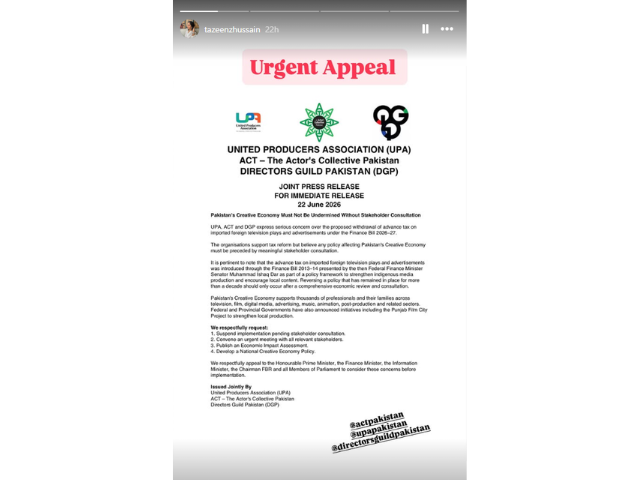
Screengrab: ACT Pakistan/Instagram
The UPA, ACT, and DGP formally presented a four-point mandate to the prime minister, finance minister, information minister, chairman of the Federal Board of Revenue, and the members of parliament, asking for an immediate suspension and halt to the implementation of the tax withdrawal pending transparent stakeholder dialogue.
Demanding an immediate round-table meeting with representatives of industry bodies in order to have an in-depth, transparent review analysing the real financial damage the bill may cause to local workers, the bodies called the establishment of a permanent, long-term national policy framework to protect indigenous art.


