


In November 2025, ESPN attended the annual Hudl Performance Insights conference — an event circled in the calendar by scouts, data analysts, sports scientists and more all across the globe, with close to 400 people making their way to London to see what the future holds for football.
Over the course of an intriguing day tucked away inside Fulham’s state-of-the-art new stand at Craven Cottage, here’s what ESPN learned about the latest innovations happening behind the scenes in football and how they could change for everyone, with insight from our resident scout Tor-Kristian Karlsen.
Clubs want more physicality … just like the Premier League
In the last few years, the English Premier League has become a battleground contested by the most athletic players around. There are physical qualities present all over the pitch — particularly in midfield — and the all-action style and relentless stamina of Arsenal‘s Declan Rice has come to define the league, while giant full backs and strong center forwards are everywhere to be seen.
One thing that was made very clear from conversations with scouts and recruitment analysts from various countries — including Italy, Germany and Portugal — is that the Premier League’s physicality is not lost on the other top European leagues, who are looking on with envious eyes in the hope of emulating it.
For example, sources told ESPN that several Italian clubs have now prioritized the recruitment of goal-scoring midfielders who stand over 6-foot tall — at least in part thanks to the work Scott McTominay did at Napoli while helping his side to the 2024-25 Scudetto. The Ballon d’Or nominee scored a remarkable 12 goals, several of which were headers following a late run into the box, and players of his style (AC Milan’s Ruben Loftus-Cheek and Udinese’s Arthur Atta already fit that description) will be on the agenda for the January window and beyond.
2:33
Marcotti: Conte reinvented McTominay, Napoli en route to Serie A title
Gab Marcotti and Craig Burley react to Napoli’s second Serie A title in three seasons under Antonio Conte.
McTominay’s influence in Italy could potentially stretch even further than that. Sources confirmed that the 29-year-old’s intensity and mentality has bolstered the already strong impression that players from Scotland have left on Serie A over the last five years, and more Italian clubs will be looking into signing players from the nation.
It’s a modern trend that Bologna kicked off by signing Aaron Hickey (now at Brentford) in 2020 and Lewis Ferguson two years later, and was continued last year by Hellas Verona signing Josh Doig, as well as Napoli acquiring both McTominay and Billy Gilmour from Manchester United and Brighton & Hove Albion respectively.
ANALYSIS: Serie A clubs have long chased this sort of “mezz’ala” [a half-winger, half-midfielder] and while McTominay may have made the trend more fashionable, players such as Sergej Milinkovic-Savic, Luca Pellegrini, Mario Pasalic and — to a degree — Charles De Ketelaere have all stood out as 6-foot-plus midfielders regularly touching the 10-goal mark.
Anecdotally, I remember Italian scouts at youth tournaments showing an obsession with these kinds of midfielders, even back in the 2000s! It likely stems from a preference for direct play and an appreciation of the work rate and strength in duels that comes with the role.
German and Spanish scouts tend to prioritize technical quality — first touch, ability to turn quickly with the ball, consistent passing and playmaking — over power and penetrative running. The trade-off with the late-arriving, strong-running midfielder is that they often see less of the ball and are often too busy timing or making deep runs to be highly involved in the build-up — unless your name is Kevin De Bruyne, of course. — Karlsen
Agents are picking the best club for their clients
Team Raiola, one of the leading player agencies in the sport, presented their player index at the Hudl conference. It’s a behemoth of a project that uses data to profile and rate tens of thousands of players, chart potential career trajectories, and assign a “potential rating” to each. Basically, they’re playing video games like EA FC or Football Manager in real life.
Players in the database are rated by statistically driven attributes, which are grouped into 8-10 categories (depending on position). Defensive, attacking, creative and physical qualities are among those considered.
They also statistically measure teams’ tactical tendencies to establish their playing style, then mesh the two together to try and find the best prospective fits for their clients should they need a transfer.
On stage, Team Raiola pointed to Ryan Gravenberch‘s move to Liverpool in 2024 as a shining example of their success using this model. Once it became clear the Netherlands midfielder’s time at Bayern Munich had come to a close, the agency pitched a move to Liverpool because their model considered it a good match.
To be clear, they’re not the only agency in football doing this. Sources confirmed to ESPN that several other major players in this space have their own version of the player index, while consultancy companies such as Analytics FC are also able to provide this sort of matchmaking upon request.
What did raise a few eyebrows in the room, though, was Team Raiola’s projection model. Using on- and off-the-ball data, the agency believes it can compare players at different stages of their development and project the level they’ll eventually reach.
The example given was a complex cluster chart that suggested PSV Eindhoven winger Ruben van Bommel, 21, is hurtling towards the level AC Milan’s Rafael Leão was in 2022 — the year that the Portugal international scored his best-ever tally of 15 league goals. While intriguing, it was met with some skepticism from the audience. As one source put it: “This is not proven science.”
Managers are using data themselves more than you think
It’s been 18 months since German manager Edin Terzic took charge of a game. That match was Borussia Dortmund’s 2-0 loss to Real Madrid in the 2024 UEFA Champions League final and in departing the club two weeks later, Terzic ended a seven-year association with the club where he’d risen from coach, to interim manager, to boss.
Terzic has used the 18 months of “downtime” to meticulously plan his next move. He met with more than 60 coaches, assistants and analysts, interviewing them to see if they’d be a good fit for his next coaching staff. From that he created a shortlist of 10-15 people he knows he can call if a job offer lands on his doorstep; and the candidates span several generations and speak lots of languages by design.
The German has also taken the time to develop custom data models to help him in his next job, giving us real-world insight into what a manager may want (and not want) from the data analysis that clubs often feed them.
You might think managers just accept the data presentations they receive and do nothing more, but Terzic spoke of his frustration when his Dortmund side’s statistics were measured on a league-wide basis. He questioned why the second-best side in the Bundesliga should be measured against the 17th- or 18th-best, given the vast difference not only in quality, but in style too.
So, with the help of an AI firm in Munich, he’s now done two things.
First, he developed a specific set of statistics that he’s happy to measure his team against others on — he calls them his KPIs. That list started at 120 and, through a process of elimination, has shrunk to 21. “Time spent in the opponent’s box” is one he likes, as it indicates a dominance in both territory and possession.
However, “Distance run” and “sprints” are not so popular. He argued that high levels of sprinting and distance covered may indicate hard work, but could also mean players have made mistakes and have been forced to recover. “I prefer my team to be in good rest defense to avoid it [sprinting],” he said.
This led to a joke about how Bayern Munich — by far the most dominant Bundesliga side in 2025-26, who have scored at least 22 goals more than anyone else this season — came to lead the distance-covered table, as the measurements don’t just turn off when the ball is out of play. “Perhaps it’s because their players so often sprint to the corner flag to celebrate goals!” he laughed.
Second, Terzic has created a custom, 17-team table featuring only elite sides — or those that play in the same style as his team — for analysis. All eight of the 2024-25 Champions League quarterfinalists are in it — Paris Saint-Germain, Inter Milan, Arsenal, Barcelona, Bayern Munich, Real Madrid, Aston Villa and Niko Kovac’s Dortmund. What this means is that when Terzic takes his next job and receives data reports from his carefully chosen analyst, it will measure his team according to the metrics he has settled on, against teams he has chosen.
In short, he wants to benchmark against Madrid, not Mainz.
Eye tests for strikers could help them score more
Damien Comolli, the new CEO of Juventus, has leaned on data wherever possible during a near-35-year career in football, which began back in 1992 alongside Arsène Wenger at AS Monaco. And during the keynote speech at the Hudl conference, he spoke of some curious research into a striker’s vision that was carried out in his previous role as president of Ligue 1 club Toulouse (2020-2025).
Acting on a gut feeling that one of his strikers was much more likely to score from crosses delivered to a certain body part, or at a certain height, he had the striker’s vision tested. And the results confirmed his suspicions.
Incredibly, crosses delivered at roughly knee height were the surest way to goal for that striker. Should the ball be delivered at any other height — including rolled along the floor — the chances of scoring dipped. The wingers were given new instructions as to how to deliver the ball moving forward. (Sadly, details of exactly how the player’s vision was tested were kept firmly under wraps.)
ANALYSIS: Comolli’s findings are undeniably interesting. I keep asking myself why more crosses aren’t delivered lower. Even if that runs against the data, my instinct is that hard, low balls across the box create the greatest danger. They’re easier for the attacker to connect with and tend to generate rebounds or “pinball” moments in high-xG areas, which are extremely hard to defend.
That said, it makes sense that knee-waist height crosses are tricky to defend as they demand a lot of body coordination from defenders who are often off-balance when trying to clear, unlike a routine header or a simple side-foot clearance on the ground. — Karlsen
Clubs are measuring their players’ personalities
To many, scouting a player’s personality is entirely separate from analyzing their physical attributes. The former relates to temperament, demeanor and mentality; the latter measures playing data like speed or type of passes. But during Comolli’s time at Toulouse, he attempted to combine the two and looked to gain insight into a player’s character via the following ideas:
– Distance run: Who works hard? Who works for the benefit of the team? Hard workers are team players.
– High number of touches of the ball: Who wants the ball? Showing for it regularly shows bravery, a willingness to take responsibility.
– Analyzing final-third actions: Players who take lots of shots may be selfish; players who take very few may be more team-oriented.
Some more traditional scouts would bristle at this strategy, but there’s a vein of logic running through it if used contextually. Comolli reached out to other clubs to help foster this research, specifically mentioning Lyon as a willing partner.
ANALYSIS: It’s fairly logical that distance covered, high-intensity sprints and touches on the ball help reveal a player’s on-pitch attitude. Offensive duels and pressing intensity also matter (with context).
One of the recurring actions that shows the least intelligence, in my opinion, is center backs shooting from 24-30 meters simply because a possession sequence has dragged on. It’s about crafting the right zones for your best shooters to strike with their stronger foot. Anything else borders on selfish. — Karlsen
Clubs are monitoring everything about a player — literally everything
Serie A side Como showed off their state-of-the-art player dashboards, which monitor performance in every sense of the word. Every kernel of data you could ever need, on every player at the club — from young hopefuls in the academy to star senior players like Nico Paz — is at the club’s fingertips.
We’re talking running and passing stats from games, sure, but it goes much deeper than that: Como want to measure their players’ wellness from every angle, so they’re collecting data from their training performances, conditioning work at the gym, injury recovery journeys, and when they sleep. They’re also monitoring players’ stress levels.
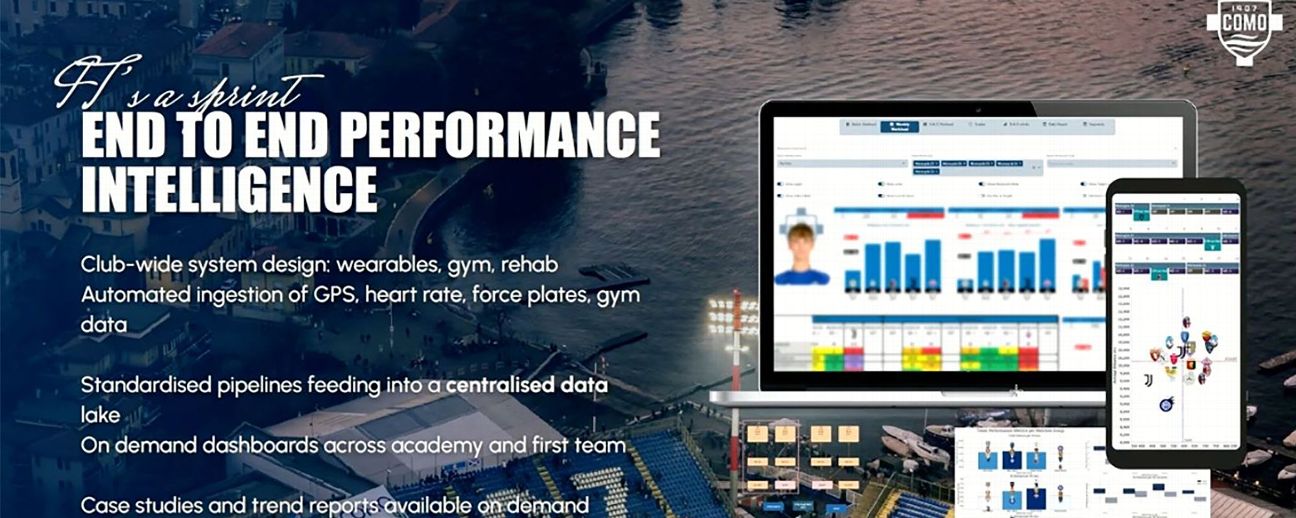
All of that feeds into one central platform (pictured above) so the club staff have every ounce of information they could ever need to manage the players. Como’s Chief Technology Officer Mo Dabbah calls it “building a 360-degree view.”
They’ve also developed a live match analysis dashboard that collects information in real time and feeds it to manager Cesc Fàbregas, helping him and his coaching staff make in-game decisions.
“We’re looking at everything,” Dabbah said. “For example, we’re trying to understand the decision-making process [a player goes through] when playing a line-breaking pass. We’re also looking at the responsiveness of the receiver [of that pass] and how quickly they react. What happens next? Did they move the ball forward, or send it back? We quantify it.”
You don’t even need a laptop to access this; Cesc could pull it all up on his phone in the dugout if needed.
Surprisingly, the Serie A side are more than happy to share this work not only with fellow professionals, but also directly with other clubs, too. They’ve had open conversations about these innovations with fellow Italian clubs such as Juventus, while the official partnership they’ve struck with Dutch club Ajax saw a curious exchange of resources as two academy products from the Amsterdam club — Lyfe Oldenstam and Miguel João da Silva — joined Como last summer in exchange for shared secrets and use of these dashboards.
Clubs want your genetic data next
The never-ending quest to keep players in peak condition is about to take an unsettling turn. It may not be long until football clubs are harnessing players’ genetic data to improve their ability to treat and condition them.
A panel including Fulham’s Head of Performance Insights, Lewis MacMillan, and Everton’s Head of First-Team Sports Science, Jack Nayler, discussed the future of player care and conditioning, and MacMillan was clear on what he wanted to see next.
“Genetic [data],” he said. “Looking at things from a genetic point of view, for personalized nutrition and training programmes.”
While mildly unnerving in theory, it does make sense in practice: This kind of information would reveal incredible things that are unique to each player, such as which foods benefit (or harm them) the most, or what may cause more inflammation in one player than another.
Meanwhile, Nayler suggested better sleep-monitoring data that was actually player-led, while football science consultant Dr. Paul Bradley wants to be able to extract everything a player sees as they briefly scan the pitch, then study it. What exactly that means — players wearing glasses with cameras, recording equipment embedded inside their retinas, or something equally Machiavellian — remains to be seen. But the future knows no bounds.


