


It happens every four years: A group of world-class soccer players disperse from their title-winning club teams across Europe’s Big Five leagues and put a pause on competing against each other in the Champions League.
For these players, their home country expects a run deep at the World Cup. Experts tab their national team as one of the heavy favorites to win it all. And then … they’re eliminated from the World Cup after just three matches.
The beauty and horror of the World Cup is one and the same. Since soccer is the most popular sport in the world and since the tournament happens only once every four years, these games are imbued with more collective meaning and emotion than anything you might see in your favorite league or even in the Olympics.
At the same time, it’s all taking place in a sport where everyone is helplessly chasing around a bouncing ball and trying to control it with their feet. Favorites in soccer win way less often than favorites do in any of the major American sports. This is why, say, the Premier League awards its champion based on an equal, cumulative schedule where you play each team twice, home and away.
And yet, the highest-profile tournament in the sport does the exact opposite: no one plays the same schedule in a World Cup, and a large chunk of the field gets eliminated after just three games.
The bounce of the ball, in other words, writes the history of the World Cup just as much as Lionel Messi or Kylian Mbappé‘s ability to control it.
At this year’s tournament, there are six clear favorites: Spain, France, England, Brazil, Argentina and Portugal. Oddsmakers have these six teams pegged as the likeliest to win the entire tournament.
If we say that each of them has a 90% chance of advancing out of their groups, then it would be quite unlikely that any one particular country gets sent packing before the knockout rounds begin. But if we take it all together — multiply 90% by itself six times — then there’s about a 50% chance (47%, to be exact) that at least one of the favorites goes home after the group stage.
So, who might it be? Let’s look at these six favorites and assess the likelihood that each gets sent home early.
– Top 50 USMNT players, ranked by club form: A new No. 1
– 9 stats that explain how Arsenal won the Premier League
– Is the World Cup worth the expense for fans?
The history of high-profile failure at the World Cup
We’ve had six different World Cups this century, and we’ve lost at least one major favorite during the group stages in each one.
In 2002, Argentina managed to score only two goals across three games and finished behind both Sweden and England in their group. In 2006, Czechia (then the Czech Republic) came into the tournament as the No. 2 team in the FIFA rankings, and despite crushing the United States by 3-0 in their opener, they lost their next two to finish behind eventual champions Italy and Ghana. Italy, of course, haven’t won a World Cup game since the 2006 final, and they finished last in their group in 2010.
Spain went home after three matches in 2014 despite entering the tournament as the defending world champs and back-to-back winners at the Euros. Germany followed suit in 2018, defending their title by finishing last in their group. And then, in 2022, Belgium’s golden generation went out with a whimper, scoring one goal across three matches and finishing behind Morocco and Croatia.
To put a little more context on all of this, here’s how each side stacked up, based on their Elo ranking and rating at the start of the tournament:
• 2002, Argentina: 2nd; 2,020
• 2006, Czechia: 4th; 1,971
• 2010, Italy: 6th; 1,936
• 2014, Spain: 2nd; 2,107
• 2018, Germany: 2nd; 2,076
• 2022, Belgium: 5th; 2,006
So, the average ranking of the eliminated favorites was fourth, and the average rating of the eliminated favorites was 2,019.
The team currently rated fourth by the Elo system? England. And their overall rating? 2,020. It may not be coming home, after all.
Which World Cup favorite is most likely to fail in 2026?
The unfortunate part of all of this is that the favorites are less likely to crash out early than ever before. Not because talent has consolidated at the top — if anything, the opposite has happened.
Rather, it’s because FIFA wants more money, even if it means a less exciting early phase of the World Cup. Since FIFA expanded the World Cup to a whopping 48 teams, the groups themselves are weaker than ever before. As I wrote about after the draw, the “group of death” is effectively dead.
On top of that, the new format means eight of the 12 third-place teams will also advance to the knockout rounds. Of the top eliminated favorites this century, just two — Germany in 2018 and Italy in 2010 — finished in fourth in their groups. So even if one of the favorites struggles through their easier-than-ever group, they’re still probably going to advance so long as they find a way to win at least one of their three matches.
That said, I still think we pretty much always overestimate the likelihood that the favorite is going to win across all of soccer — and especially at the World Cup. Just take the most recent Premier League season. When Manchester City beat Arsenal in April and caught them atop the table, most of what you would’ve read or heard about the title race was that City were now going to win the league. But even if you thought City were favorites — the betting markets did, most projection systems did not — they were only a 60% favorite, at best. And well, things with a 40% likelihood or smaller are happening all around us, every day.
Using the 90% back-of-the-napkin math from above, there’s an even better chance that at least one of these teams gets knocked out before the round of 32. With that, here are the World Cup favorites who may implode at the tournament, ranked from least likely to most likely.

If you want to make the case for England to fail, I think it’s twofold: They have only one guy who can score goals named Harry Kane, and they play too conservatively.
If that sounds a lot like new Premier League champions Arsenal, then it should. The Gunners just won the title on the back of historic set-piece dominance, conservative in-possession play, and the best defense in the world.
But as we saw during their struggles in late winter and early spring, sometimes the grind-it-out approach leads to a lot of low-event games when you don’t create enough chances to score and/or the other team converts one or two of the handful of chances you do concede. In a knockout tournament setting, that can be a problem.
However, under manager Thomas Tuchel, England barely ever concede goals. They move the ball up the field incredibly slowly, and their matches have featured significantly fewer possessions than that of any Premier League team this season.
1:46
Olley: Tuchel has taken Southgate’s England approach even further
James Olley discusses Thomas Tuchel’s England squad selections, arguing that Tuchel has taken Gareth Southgate’s approach even further by leaving out several high-profile players.
Now, “never concede” and “have Harry Kane” is a pretty good formula for international success. But Kane has scored 11 non-penalty goals for England in competitive matches since the start of 2024, and no one else has more than three.
The squad Tuchel chose is mostly bereft of creative passers, too. If they disappoint this summer, it’ll be because they can’t generate enough opportunities on goal. Sounds a lot like the last guy in charge, no?

I would’ve had Spain as the least likely favorite to get bounced early, but returning-from-injury Lamine Yamal isn’t playing in the first match, and we really have no idea how healthy he’ll be once he’s back, either.
Add in the fact that (1) Rodri still hasn’t quite looked like himself since returning from injury this season and (2) Pedri feels like he’s on the verge of a hamstring injury every time he steps on the field, and there are question marks around the performance of Spain’s three major stars.
If you want to get weird with it, then there’s also the Euro Winner Curse. Since 1988, the team that won the Euros has only advanced past the quarterfinals of the following World Cup one time, and only one other team has even reached the quarterfinals. So, of the previous nine European champions, seven haven’t even won a single knockout match at the following World Cup.
The one team that made it past the quarters, of course, was Spain in 2010, when they won the whole thing.
That’s all trivia, more than anything, but Yamal is the load-bearing beam of Spain’s whole attack — much like he’s become at Barcelona. What happens if he’s not himself this summer?
The main issue with this team is that … it’s the least talented Brazil team of my lifetime?
There are three players on the roster who I would confidently describe as world-class: Vinícius Júnior, Raphinha, and Gabriel Magalhães.
Wanna throw Marquinhos in there, too? Fine, I’ll give you four. And this time last year, before an injury-plagued season, I would’ve added in Bruno Guimarães. And Alisson Becker is obviously one of the best goalkeepers of the modern era of the sport — but he hasn’t played like that in a couple seasons.
Plus, when was the last time we saw Carlo Ancelotti coach a team to overachieve its talent level? Most of his career has been built on coming into clubs with tons of talent that didn’t really fit together and figuring out a way to make it all work with the best guys on the field. Given the off-field meltdown that’s been happening at Real Madrid this season, Ancelotti was clearly doing all kinds of great managerial work to keep everything falling apart.
Ancelotti also seems to have a predilection for attacking soccer, while most coaches tend to be too conservative — that’s driven his success, too. Is that what this Brazil team needs, though?
Raphinha is the perfect star — he can play pretty much any attacking role you want, on and off the ball — and he’s the exact kind of winger you’d want to play on the opposite side from Vini Jr., who has reached the point in his career where he doesn’t defend and thus requires his teammates to pick up the slack. There’s not even really enough talent on this roster that it seems like it’ll require Ancelotti’s expert ego-balancing, either.
That said, Brazil’s draw turned out favorably for them, and their group opponents just don’t seem like they’ll have enough juice to keep A Seleção from picking up enough points.

I think France have the most talent in this tournament — by far. I also just think they’re the best team, full stop.
Despite that, I wouldn’t be shocked if they got sent home early. This has pretty much nothing to do with how the team plays or how they function, either.
Yes, they’ve been a little too conservative for long stretches under manager Didier Deschamps. But they’ve made the last two World Cup finals under him, and I really don’t know how conservative you can actually be when your starting front three is going to be Michael Olise, Ousmane Dembélé, and Kylian Mbappé.
Now, whenever a favorite gets dumped out in the group stages, it must be a treated as a referendum: on the manager, on the priorities of the players, on the country’s belief in how young athletes should develop, on the country’s comprehensive value system beyond sports. But most of the time it’s mostly just random chance: a hard draw and some bad bounces.
Take Germany at the last World Cup. They got drawn in the same group as Spain, and then the ball just wouldn’t go in the net. Here’s how all 32 teams stacked up for the non-penalty expected goal differential during the group stages in 2022:
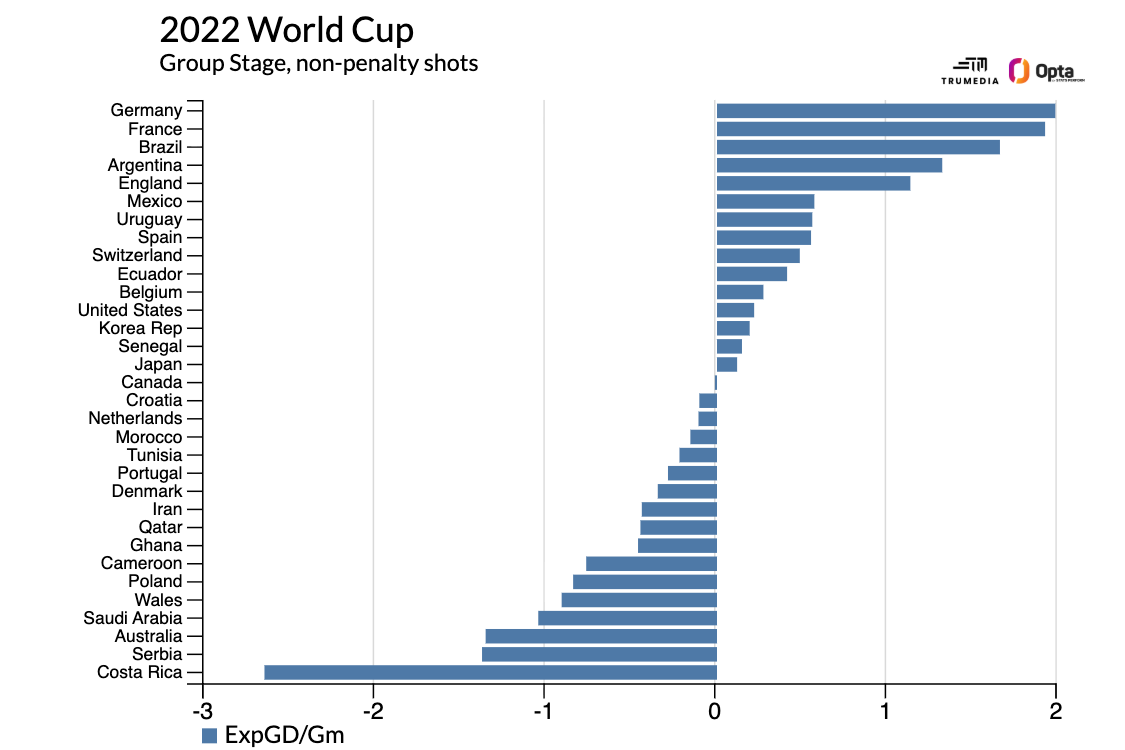
Germany did the thing that wins soccer games — create better chances than your opponent — better than everyone else, and they still got knocked out before the knockout rounds. That could happen to France, or any of these other sides, too.
I’m singling out France, in particular, because they’re in the same group as Senegal (17th in Elo) and Norway (11th in Elo). If they don’t win either of those matches, then all that’s needed for them to get eliminated is a bad result against Iraq, who aren’t quite as bad as some of the other minnows in the tournament.

After not winning anything for all of Lionel Messi‘s prime, Argentina proceeded to win everything during the twilight of his career. They’ve sandwiched back-to-back Copa America trophies around winning the 2022 World Cup, and they come into this tournament having easily finished first in CONMEBOL’s grueling qualifying run.
Based purely on results, they’re the favorites to win it all.
It’s just that we’ve seen this story too many times: team wins lots of trophies by landing on the right generation of players — a blend of talent and manager that sync up just right — but then they ride that mix just one tournament too far.
Take a look at their 11 most-used players from qualifying:
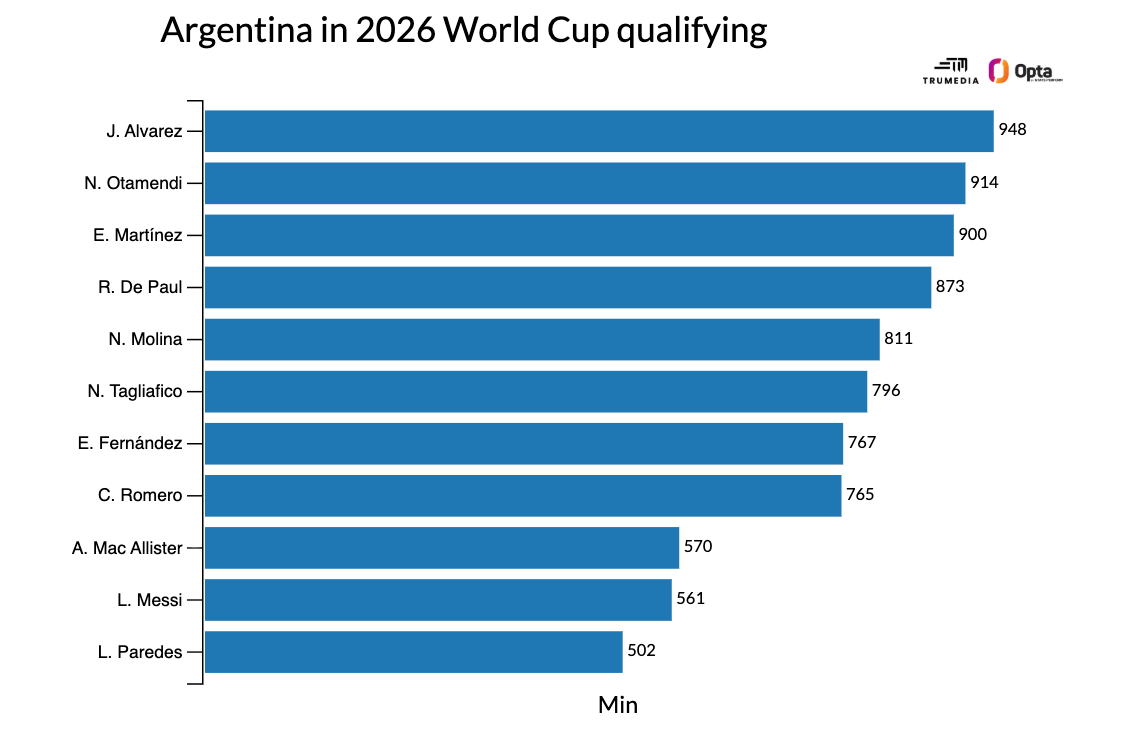
Notice anything familiar? Ten of those guys started the World Cup final, and the 11th, Leandro Paredes, played five matches in Qatar, too.
All of these players are four years older, and almost all of them are four years worse than they were at the last World Cup — including the best player at the last World Cup, Lionel Messi. There’s been very little turnover to this group, and it’s worked brilliantly, but it won’t work forever.
Two of Argentina’s group stage opponents — Austria, with their Red Bull-inspired high press, and Algeria’s super-young squad — are the kinds of energetic teams we’ve seen upset aging favorites in the past.
It might be unfair to lump Portugal in here. They don’t have the track record of success of any of these other countries — they’re the only one of the six without a World Cup. And as such, they also don’t have the structural advantages that allow the other five to pretty much automatically be contenders every four years.
The population of Portugal is the same size as the population as the Dominican Republic — and yet they’re on a six-long list of World Cup favorites and are being grouped in with the possible winners.
But Portugal’s biggest weakness is what used to be their biggest strength.
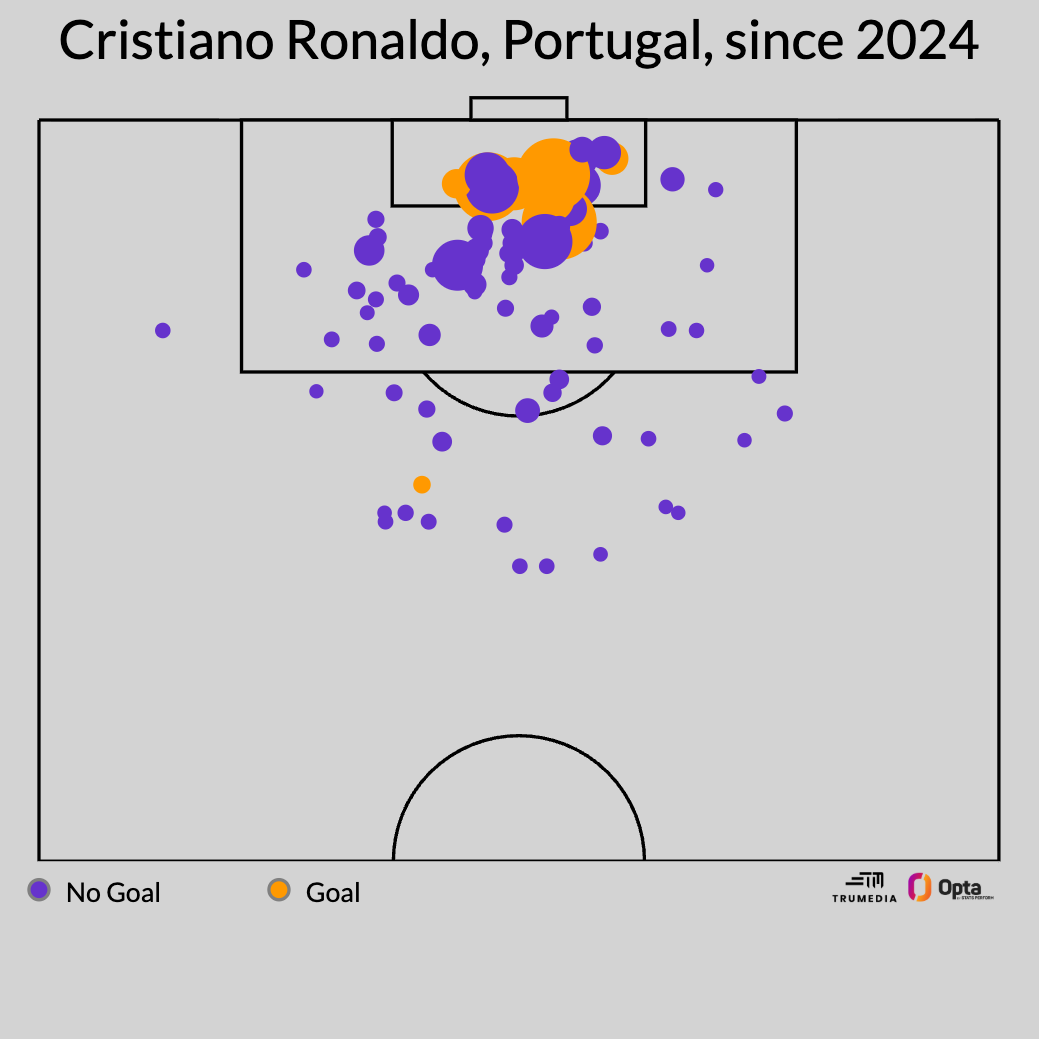
Since the start of 2024, Cristiano Ronaldo has scored 26% of Portugal’s non-penalty goals and generated 37% of their expected goals in competitive matches.
It’s just, well, that he’s 41 years old, and we haven’t seen him play consistent high-level soccer since before the last World Cup. It’s amazing that the guy is still playing and producing, anywhere, but the Saudi Pro League is horrible.
Joshua King, who averaged 0.34 non-penalty goals+assists per 90 minutes across seven Premier League seasons, just averaged 0.86 per 90 for 12th-place Al Khaleej as a 34-year-old. That’s slightly better than what Ronaldo averaged for the best team in Saudi Arabia this season. And if I told you that a 34-year-old Joshua King was starting up top for Portugal, you wouldn’t feel great about it, would you?
Perhaps the most concerning part is that there isn’t really anyone else to slot in, either. The only other center forward option on the roster is Gonçalo Ramos, who led Portugal in goals at the last World Cup and started both of their knockout-round matches over Ronaldo. He’s only 24, but his career has stalled out since he moved to Paris Saint-Germain soon after the tournament.
So, some 20-plus years after he made his national-team debut, Portugal seem like they’re going to run it back one last time: they’re going to live-and-die by Cristiano Ronaldo.


