


Trump says Ukraine war depleted U.S. weapons stockpiles, but as Iran takes that mantle, Kyiv sees opportunities


Kyiv — The White House wants Congress to provide at least $200 billion more in funding for the war in Iran, and President Trump says that’s partly due to aid for Ukraine having depleted U.S. weapons stockpiles as it fends off Russia’s ongoing full-scale invasion.
“This is a very volatile world,” Mr. Trump said Thursday. “We want to have vast amounts of ammunition, which we have right now — we have a lot of ammunition, but it was taken down by giving so much to Ukraine.”
Throughout his second term, Mr. Trump has criticized the Biden administration for, in his view, providing armaments to Ukraine that America’s defense industry could not quickly replenish.
Last summer, after a review of stockpiles, the U.S. paused the shipment of some weapons to Ukraine. Those weapons transfers were eventually reinstated under a new initiative that sees NATO allies foot much of the bill, but the episode made it clear the White House considers support for Ukraine’s defense an obstacle to ensuring America’s own defensive stockpiles remain up to the demands of any future conflict.
Now, however, Ukraine is offering reasons to reassess that viewpoint. As the war in Iran depletes U.S. stocks of interceptor missiles, Ukrainian officials are offering deals to help replenish them. On Saturday, Ukrainian officials met Trump administration representatives to discuss, among other topics, a deal for the two countries to co-produce drones and drone interceptors.
Alex Nikitenko/Global Images Ukraine/Getty
President Volodymyr Zelenskyy has said the agreement could be worth between $35-50 billion. He’s also said there are several other potential deals in the works with America’s Persian Gulf allies, whose urgent need for Ukrainian drone interceptors has become a public matter amid Iran’s relentless attacks.
But experts say the deals currently materializing extend beyond immediate air defense needs in the Middle East, and they could lay the foundation for longer-term U.S.-Ukraine defense industrial partnerships.
Iran war eating up Patriot interceptor missiles much faster than Ukraine
Soon after the U.S. began providing weapons from its own arsenal to Ukraine in 2022, concerns emerged over the ability of America’s defense industry to replace them. Most alarming were potential shortages of Patriot Advanced Capability-3 (PAC-3) interceptor missiles, which are among the most effective weapons to shoot down incoming ballistic missiles.
“We realized that we now had a defense industrial base with no excess capacity to ramp up for wartime requirements,” Matt Tavares, a defense analyst who served as a Pentagon adviser for multiple administrations, told CBS News. “Some of the equipment that we gave to the Ukrainians could not be immediately backfilled by the defense industry.”
When President Trump returned to power in 2025, his administration promised to jumpstart production of air defense munitions and to be more judicious about doling them out to allies. Beginning last summer, some military shipments were redirected, including 20,000 anti-drone missiles originally intended for Ukraine that were instead sent to U.S. Air Force units in the Middle East.
In January, the Pentagon announced a deal with Lockheed Martin to triple production of Patriot interceptors.
But the war in Iran has complicated the Defense Department’s weapons conservation efforts.
America’s Middle East allies burned through 800 Patriot interceptors as they fended off Iran’s retaliatory attacks during the first week of the war alone, according to Zelenskyy, who noted that his country had used only 600 of the Patriots during four years of war with Russia.
Experts have said the rapid use of these expensive munitions is likely driving, at least in part, the White House’s request for another $200 billion from Congress — which is nearly four times the $70 billion in military aid provided to Ukraine since 2022.
“To the extent that U.S. stockpiles are being depleted, it has much more to do with what has been going on in the Middle East over the last nine months than what has happened in Ukraine,” Thomas Karako, director of the Missile Defense Project at the Washington D.C.-based Center for Strategic and International Studies, told CBS News.
Can Ukraine offer long-term solutions to shore up U.S. weapons stockpiles?
As the Iran war drains interceptor stockpiles, the U.S. and its Gulf allies have turned to Ukraine for its drone defense expertise. President Zelenskyy said last week that Ukraine had sent more than 200 drone experts to the Middle East to help defend military installations and civilian centers from Iranian attacks.
In return, Ukrainians hope to receive more of the Western interceptor missiles that have been so crucial to their own air defense. Asked by journalists in Kyiv last week whether missile shipments from the U.S. and Europe to Ukraine could be further disrupted due to the Iran war, Zelenskyy said, “the risk is very high,” and stressed that getting more Patriot missiles was “our priority.”
Getty 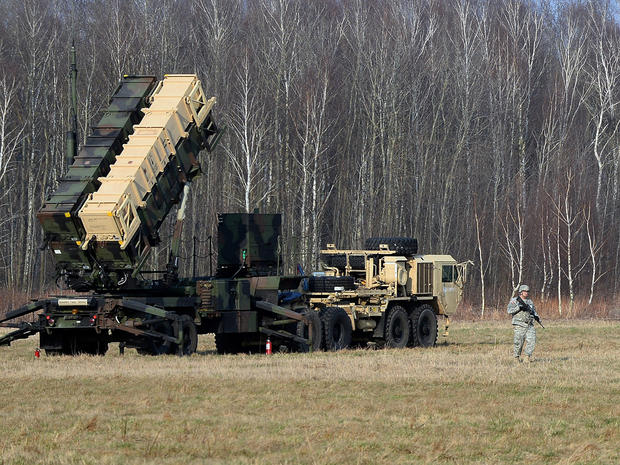
But the deals now in the works between Kyiv and Washington, and Kyiv and Gulf states, likely won’t yield direct swaps of armaments to bolster Ukrainian or Middle Eastern air defenses in the short-term.
“The problem is how quickly we can actually produce Patriot interceptors. I would imagine that the Gulf, right now, they want to hold onto all of their interceptor stocks because they don’t know when they’ll be backfilled,” Dara Massicot, a senior fellow at the Carnegie Endowment for International Peace, told CBS News.
She said it could be, for Ukraine, more about long-term gains.
“There is a way here where they could partner on drones, get that capital investment, and then that money that flows into the defense sector can be used to develop niche things like long-range strike or air defense know-how,” Massicot said.
That kind of arrangement could also prove just as beneficial politically for Kyiv, even if it doesn’t help with its immediate war needs.
“This could be a moment where the Ukrainians helping out here elicit some good will on the part of the United States, and show that they are a contributor, and not merely a drain on security resources,” said Karako.


