


US-Iran conflict disrupts thousands of flights as travel chaos deepens


- Middle Eastern airport hubs remain closed or restricted.
- Airlines reroute or cancel flights, affecting global schedules.
- Risk of prolonged disruption due to regional conflicts.
DUBAI: Global air travel remained heavily disrupted on Sunday as continued air strikes kept major Middle Eastern airports, including Dubai, the world’s busiest international hub, closed in one of the sharpest aviation shocks in recent years.
Key transit airports including Dubai and Abu Dhabi in the UAE, and Doha in Qatar, were shut or severely restricted as much of the region’s airspace remained closed, with the Gulf grappling with uncertainty after U.S. and Israeli strikes killed Iranian Supreme Leader Ayatollah Ali Khamenei on Saturday.
Israel said it launched another wave of strikes on Iran on Sunday, while loud blasts were heard for a second day near Dubai and over Doha, after Iran launched retaliatory air attacks on the neighbouring Gulf states.
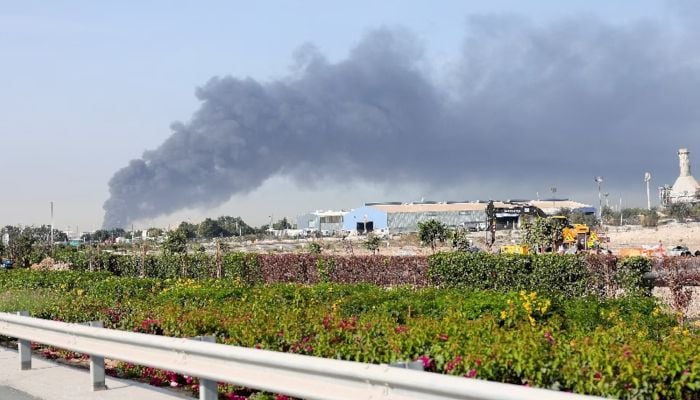
Dubai International Airport sustained damage during Iran’s attacks, while airports in Abu Dhabi and Kuwait were also hit. Thousands of flights have been affected across the Middle East since the U.S. first launched attacks on Iran on Saturday, according to data on FlightAware, a flight tracking platform.
Ripple effects
The airport closures have rippled far beyond the Middle East. Dubai and neighbouring Doha sit at the crossroads of east-west air travel, funnelling long-haul traffic between Europe and Asia through tightly scheduled networks of connecting flights.
With those hubs idle, aircraft and crews remained stranded out of position, disrupting airline schedules worldwide.
“It’s the sheer volume of people and the complexity,” said UK-based aviation analyst John Strickland.
“It is not only customers, it is the crews and aircraft all over place.”
Airlines across Europe, Asia and the Middle East cancelled or rerouted flights to avoid closed or restricted airspace, lengthening journeys and driving up fuel costs. The disruption has been intensified by the loss of Iranian and Iraqi overflight routes, which had grown more important since the Russia-Ukraine war forced airlines to avoid both countries’ airspace.
The Middle East airspace closures were squeezing airlines into narrower corridors, with fighting between Pakistan and Afghanistan adding a further risk, said Ian Petchenik, communications director at Flightradar24.
“The risk of protracted disruption is the main concern from a commercial aviation perspective,” Petchenik said.
“Any escalation in the conflict between Pakistan and Afghanistan that results in the closure of airspace would have drastic consequences for travel between Europe and Asia.”
Middle East flights halted
Airspace over Iran, Iraq, Kuwait, Israel, Bahrain, the UAE and Qatar remained virtually empty, maps by flight-tracking service Flightradar24 showed, and air strikes kept major Middle Eastern airports, including Dubai, Abu Dhabi and Doha shut or severely restricted.
Below is the latest on flights listed by airline in alphabetical order:
Aegean Airlines
Greece’s largest carrier suspended flights to and from Tel Aviv in Israel, Beirut in Lebanon and Erbil in Iraq until March 2.
Air Astana
The group cancelled all flights to the Middle East through March 3.
Air Canada
The airline said it has cancelled flights from Canada to Israel until March 8 and flights to Dubai until March 3.
Air Europa
The Spanish airline cancelled its flights to Tel Aviv on Sunday and Monday and is monitoring the situation to assess operations from Tuesday.
Air France KLM
Air France cancelled flights to and from Tel Aviv in Israel and Beirut in Lebanon for Saturday.
Its Dutch arm KLM said late on Saturday that this weekend’s flights to and from Dubai, Dammam and Riyadh have been cancelled. It had already brought forward suspension of its Amsterdam–Tel Aviv service to Saturday.
Air India
The carrier cancelled flights scheduled for Sunday from Delhi, Mumbai and Amritsar to London, New York, Chicago, Toronto, Frankfurt and Paris. It added that more flights to London, Birmingham, Amsterdam, Zurich, Milan, Vienna, Copenhagen and Frankfurt had been cancelled.
Azerbaijan Airlines
The airline has suspended flights to and from Dubai, Doha, Jeddah and Tel Aviv.
British Airways
IAG-owned British Airways said it has cancelled flights to Tel Aviv and Bahrain until March 3 and its flight to Amman on Saturday.
Cathay Pacific
Hong Kong’s Cathay Group, parent of Cathay Pacific Airways, suspended operations in the region, affecting passenger flights to and from Dubai and Riyadh, as well as freighter service at Al Maktoum airport. That is Dubai’s second airport after Dubai International Airport, the primary hub that handles most passenger traffic.
Emirates
Owing to multiple regional airspace closures, Emirates has suspended all operations to and from Dubai until 3pm UAE time on March 2.
Etihad
The UAE’s Etihad said flights scheduled to depart Abu Dhabi were suspended until 2pm local time on Sunday.
Flydubai
The airline said it had temporarily suspended all flights to and from Dubai until 3pm local time on Sunday.
Iberia Express
The Spanish airline owned by Iberia Group cancelled a flight to Tel Aviv scheduled for Saturday at 5pm local time.
IndiGo
IndiGo, India’s biggest airline, said it had extended a temporary suspension of select international flights using Middle East airspace until Monday.
ITA Airways
ITA Airways suspended flights to and from Tel Aviv and said it would not use the airspace of Israel, Lebanon, Jordan, Iraq and Iran until March 7. Flights to and from Dubai were suspended until March 1.
Japan Airlines
Japan Airlines cancelled a flight on Saturday from Tokyo Haneda to Doha as well as a return flight on March 1, Nikkei said.
LOT Polish Airlines
The airline suspended flights to Tel Aviv until March 15 and cancelled flights to Dubai and Riyadh until March 2.
Lufthansa
The German airline flights to and from Tel Aviv in Israel, Beirut in Lebanon and Oman until March 7 and flights to and from Dubai on Saturday and Sunday.
It also said it would not fly through Israeli, Lebanese, Jordanian, Iraqi and Iranian airspace until March 7.
Norwegian Air
The Nordic airline suspended all flights to and from Dubai until March 4, a company spokesperson said. The carrier did not suspend flights to Tel Aviv in Israel or Beirut in Lebanon because these destinations are only active in summer, he added.
Pegasus Airlines
The airline said that flights to Iran, Iraq, Jordan and Lebanon were cancelled up to and including March 2.
Qatar Airways
The airline said flights remain temporarily suspended owing to the closure of the Qatari airspace. It will provide a further update by 9am local time on Monday.
Scandinavian Airlines
The airline told Reuters it had suspended its flight to Tel Aviv from Copenhagen on Saturday. No decision had been made regarding flights on later dates.
Turkish Airlines
The airline cancelled flights to Qatar, Kuwait, Bahrain, the United Arab Emirates and Oman on Saturday and flights to Lebanon, Syria, Iraq, Iran and Jordan until March 2.
Virgin Atlantic
Virgin Atlantic said it will temporarily avoid Iraqi airspace, resulting in some pre-planned rerouting of flights and has cancelled its VS400 service from London Heathrow to Dubai on Saturday.
Wizz Air
The Hungarian carrier halted flights to and from Israel, Dubai, Abu Dhabi and Amman with immediate effect until March 7.
It added that operational decisions would continue to be reviewed and the flight schedule could be adjusted as the situation evolves.


