


Intriguing finds could solve mystery of women in medieval cemetery


Rebecca Morelle,Science Editorand
Alison Francis,Senior Science Journalist
 Kevin Church/BBC News
Intriguing new discoveries in a medieval cemetery in Wales have brought archaeologists closer to solving the mystery surrounding the women buried there.
They’ve found what appears to be a small building and have unearthed domestic and decorative artefacts, including exquisite coloured glass beads.
So far 58 skeletons, dating to the 6th or 7th Century, have been uncovered at the site. What’s unusual is that nearly all belonged to women.
The new finds add to growing evidence that the burial ground was part of an early female religious community.

 Kevin Church/BBC News
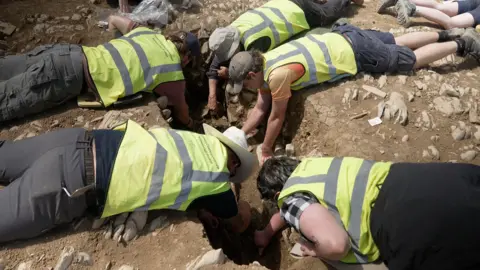
For the last four years, archaeologists have been excavating the site in the grounds of Fonmon Castle, close to the end of the runway at Cardiff airport.
The skeletons are buried in shallow graves cut into the limestone bedrock. While their bones and teeth show they lived hard lives, objects found amongst the graves suggest wealth and luxury.
The team have been scratching their heads trying to work out who these women were.
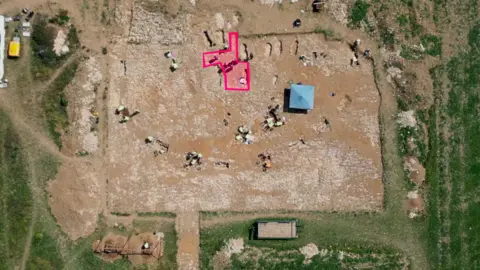
Now the latest dig has provided a major clue: the outline of what could possibly be a small building.
“It’s producing fragments of building stone, so it might be structural. We might be thinking of a small shrine or a chapel,” says Dr Andy Seaman, from Cardiff University, who is leading the dig.
“I do think that we have a site which may be an early religious community.”
 Kevin Church/BBC News
The potential building is located in the centre of the cemetery and graves are clustered around it. It seems that people wanted to be buried as close to this feature as possible.
So close in fact, says Cardiff University archaeologist Tudur Davies, that some of these graves have several people in them.
“It’s a highly desired location for people to be buried in,” he says.
“Sometimes two, three, four individuals have been buried on the same spot, again and again. There doesn’t appear to be as much of a taboo over putting bodies in the same place and just moving those still there to one side.”
Artefacts found at the site are revealing more about the people buried here.
 Kevin Church/BBC News
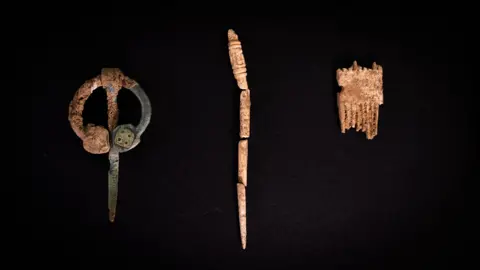
The objects have been taken to Cardiff University’s lab. Conservator Clare Emerson is painstakingly removing the dirt of the dig from an ornate copper brooch.
“We’d have to do some more analysis, but it’s probably bronze,” she says. “Also we think it was possibly gilded, which would be a coating of gold over the top.”
The ends, she explains, were covered in green enamel.
“This would have been a very decorative brooch. I think it’s a very special find for the site.”
Alongside this piece of medieval bling, the team have also unearthed a pin made from bone with a detailed pattern and a comb intricately carved from antler.
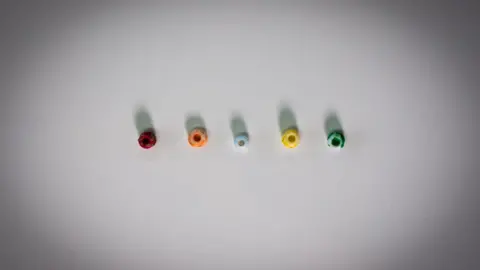
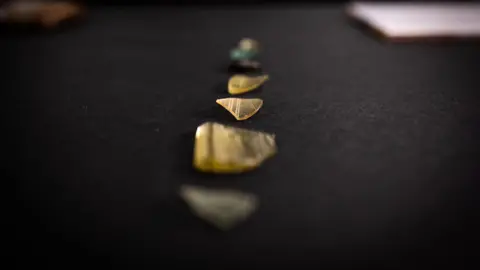
And there are some exquisite, multicoloured glass beads. Measuring about 3mm across, each one is a miniature delight. They were possibly stitched onto clothing or attached to a piece of jewellery.
 Kevin Church/BBC News
But the domestic items found at the site tell us a lot too.
“We have a quern stone for grinding flour for bread. We’ve got pottery and glass for eating and drinking” says Dr Andy Seaman.
“It’s clearly not just a place for the dead. There’s a living community here as well.”
He thinks that the community was enclosed, living right next door to the cemetery, separated from the rest of society.
 Kevin Church/BBC News
The pieces of this medieval puzzle are starting to come together. But there are still some questions.
The remains of a few men have been found – who were they? And some children too – were they related to any of the women?
And while most of the people at the cemetery were buried with great care, two women were tossed in a ditch – one with her hands and feet tied. What had they done to deserve that?
 Kevin Church/BBC News
The team are now trying to work out if this could be an example of very early Christianity.
“It’s a period where the history is not yet written,” says Dr Seaman.
“We don’t really understand early church sites… how they functioned, what they looked like, how they were organised.
“We know that very well from later periods, but in this very formative period of history, it’s not very well understood. So it’s a really exciting opportunity.”
The archaeologists will continue their excavations later this year.


