


After the first four round-of-32 games in World Cup history, I think we were all asking the same question:
What?!
Just like we all predicted, the first four teams through to the round of 16 are Brazil … Canada, Paraguay and Morocco. Germany lost a shootout for the first time in World Cup history. Netherlands also lost a shootout — and OK, fine, they always do that, but the forebears of Total Football played a game where they had only 32% possession, their lowest for any World Cup game on record. Also: Canada are currently the only team in World Cup history with a perfect, 100% win rate in knockout-round matches.
With its 20-something shots per game and its two or three goals, soccer is random enough as is, but introducing an extra single-elimination round to the World Cup has added another layer of volatility to the world’s greatest sporting event. The chaos is likely to continue, but even if it doesn’t: we’re still only four games into this thing, and four games isn’t close to enough match time for us to produce any kind of confident conclusions about who is left.
So, we’re going to go a little deeper than the collective “what?” that you probably could’ve heard from outer space right after Morocco forward Ismael Saibari’s penalty hit the back of the net. We’re going to pinpoint the biggest question for each team that qualifies for the round of 16, and we’ll be updating this page as more teams qualify, with the most recently qualified teams listed at the top.
All numbers come courtesy of the stats app Futi or Stats Perform data, unless otherwise noted. All projections cited come from Michael Caley’s PADDLIN’ model.
The big question: What happens without Folarin Balogun?
If you zoom out far enough and go beyond the realm of tactics or schedule or even home-field advantage, then there’s a pretty simple story that explains the USMNT’s improvement over the past four years: soccer is defined by what happens inside the penalty area, and the USMNT now has much better players inside both penalty areas.
On the defensive end, Tim Ream‘s center back partner was either Walker Zimmerman or Cameron Carter-Vickers in Qatar. The fact that I’m using “either/or” to describe the one position on the field other than goalkeeper that almost never gets subbed out tells you everything you need to know.
Fast-forward to 2024, and Ream’s partner is Chris Richards, US Soccer’s 2025 player of the year and a starter for a Premier League team that’s won the FA Cup and the Conference League over the past two seasons.
On the attacking end, Josh Sargent, Haji Wright and Jesús Ferreira all played significant striker minutes — and their only goal came from an accidental deflection off of Wright’s heel in the round of 16 against the Netherlands. Wright is now the third-choice center forward, while Sargent and Ferreira didn’t even make the 2026 World Cup squad.
Center forward was the weakest link for the 2022 squad. Four years later, the co-host’s best player has been their center forward.
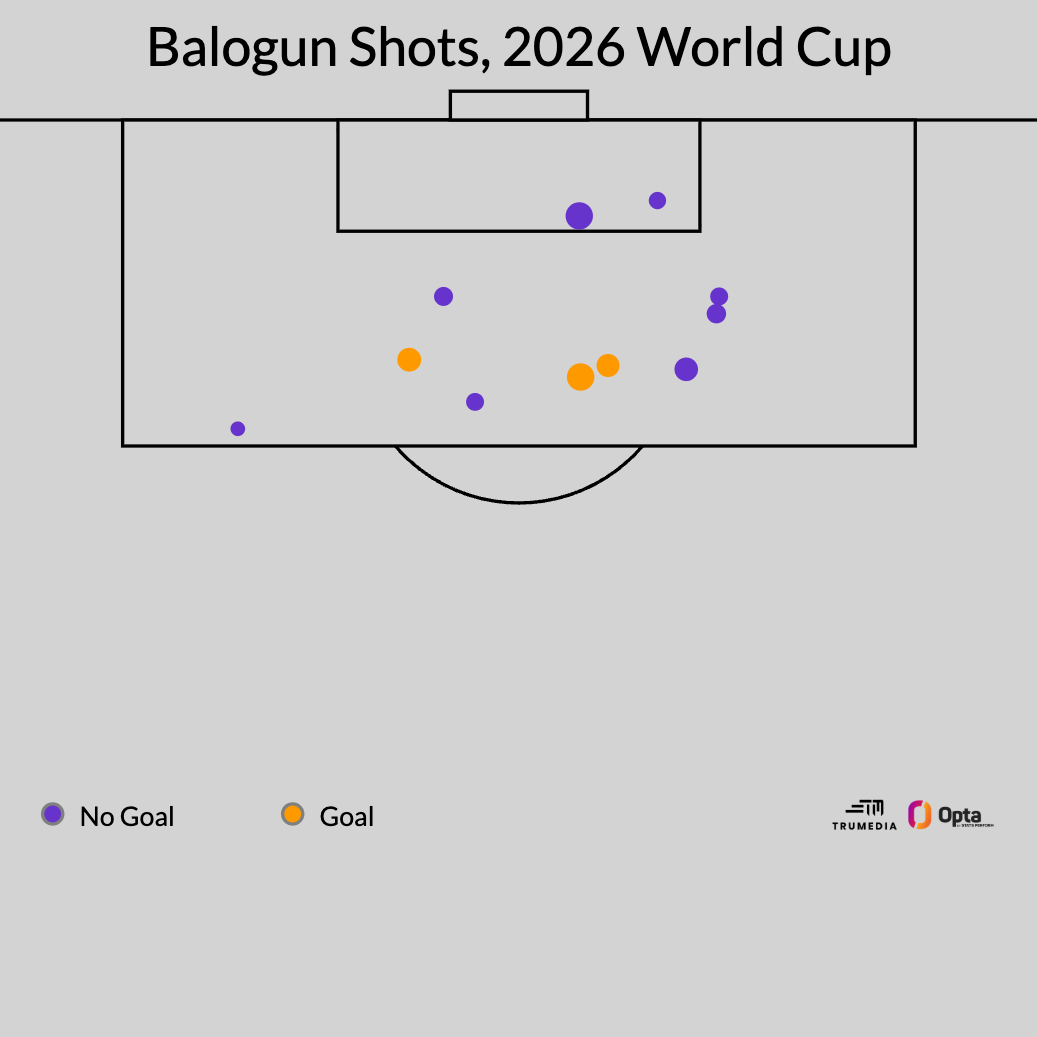
Through three games, Folarin Balogun has attempted 11 shots and scored three goals — averaging out to 1.2 goals and 4.4 shots per 90 minutes, both of which would be close-to-best-in-the-world rates in a top European league. He does what every great striker does, and what maybe no U.S. striker ever has: gets lots of great shots.
Orange are goals, and the dots are sized by the expected-goal value of the attempt:
Futi takes it a step beyond goals and looks at everything a player does on the ball to estimate how much it all increases his team’s chances of scoring and decreases his team’s chances of conceding. The numbers then get normalized by position and opponent and put on a 1-to-99 scale.
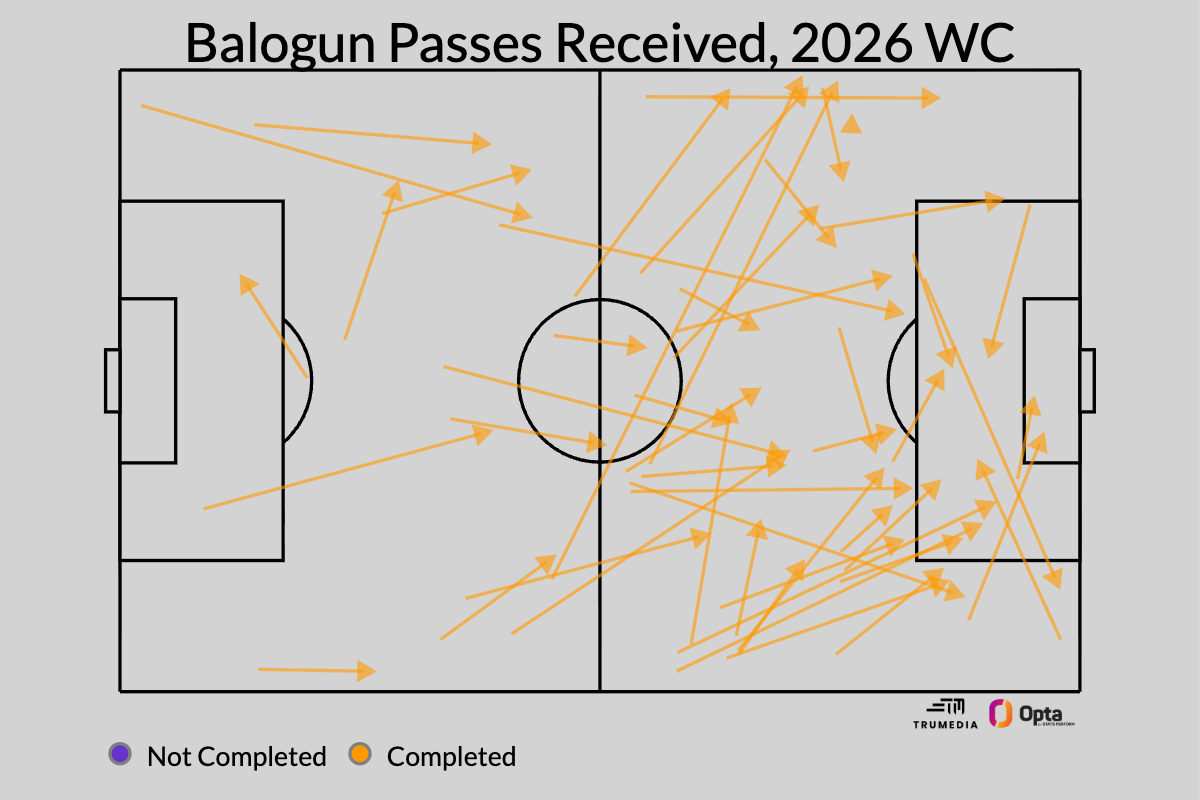
Balogun currently grades out in the 81st percentile — by far the top performer on the USMNT. And he’s in the 99th percentile for the quality of the passes he receives — an outcome determined as much by his savvy movement and explosiveness as the skill of the U.S.’s passers.
He’s been especially dangerous with his runs into the right half-space toward the edge of the penalty area:
Now, for the the gigantic elephant in the pitch-side monitor: Balogun is suspended for the USMNT’s next game against Belgium. When he’s been on the field, the 24-year-old has accounted for 46% of the team’s xG and 44% of their shots. At the time of his sending-off against Bosnia-Herzegovina, he’d taken four of the team’s five shots.
Mauricio Pochettino’s USMNT is the best version of the team we’ve ever seen. The players press aggressively and effectively as a team, the pieces fit so well together, and they have various systematic ways of moving the ball up the field that most national teams simply do not. But in the attacking third, you still need players who can make decisive plays in high-leverage moments, turning your dominance into goals.
Balogun’s likely replacement against Belgium, Ricardo Pepi, is Futi’s lowest-rated American player thus far, at a 37 out of 100. If he plays, he’ll be able to maintain the team’s aggressive press — and maybe even improve it — but he seems unlikely to create any of the advantages that Balogun does.
How will the team score in the round of 16? While the USMNT hasn’t really needed to rely on Christian Pulisic yet, somehow, that’s going to change Monday.
 Belgium
The big question: Did they find something in the final 15 minutes against Senegal?
After the first 75 minutes of their round-of-32 match against Senegal, Belgium weren’t just down, 2-0. They might’ve been lucky to only be down 2-0. They looked broken, beaten, busted-up, and finished. There’s one generation-ending blowout in every World Cup — a once-great team hangs onto its former starts for too long — and this seemed like it.
0:40
Brussels watch party goes wild as Tielemans wins it late for Belgium
Through 27 minutes, Senegal had created 2.66 xG, while Belgium had only mustered a measly 0.36 despite trailing since the 24th minute. From then on, they outscored Senegal, 3-0, and flipped one of the most unlikely World Cup comebacks I can remember seeing. It’s specifically so unlikely because it all happened with Jérémy Doku and Kevin De Bruyne, theoretically Belgium’s two best players, not on the field. Both were subbed off early in the second half.
If Belgium play like they did against Senegal against the USMNT, they’re going to get destroyed. And even during the comeback, they weren’t really dominant or anything like that: 1.35 xG to 0.92 from the 76th minute on, and more than half of their xG came from the controversial penalty kick in the final minute of the match.
This team really feels like they’re wobbling, waiting for someone to deliver the knockout blow. The only way that won’t be true is if something fundamentally changed after Rudi Garcia made all of his second-half subs.
The big question: What happens if they ever have to defend?
There are obvious issues with England’s attack. They’re not great against low blocks. Their wingers can’t create any danger. There’s no creativity in the middle of the field. And it pretty much always comes down to Harry Kane or Jude Bellingham doesn’t something special.
The thing is, though: Harry Kane and Jude Bellingham are two of the best players in the world, and when you have two of them, there’s a pretty good chance that something special happens every game.
England have eight goals and 8.3 xG through four games. If you told me that this team would be sustainably producing two goals worth of chances every match before the tournament, I would’ve quit my job, bet all of my money on England winning the World Cup, and then retired somewhere that the Internet doesn’t exist.
The bigger issue with England, though, might be the defense. They’ve heavily tilted the field in all four of their matches — 71% of final-third possession, third-most among remaining teams — but I really don’t think they’ve looked stable whenever their opponent has been able to break into their defensive third. The opening half-hour of the Congo DR match was shocking because England’s opponents actually contested possession and created multiple quality chances. Both Ghana and Croatia rarely attacked, but they both looked dangerous whenever they did.
0:59
Hutchison: England can’t rely on their starting XI alone at the Azteca
From a pure talent perspective, especially with Reece James injured, England’s defenders and their goalkeepers are their weakest starters. Djed Spence, Marc Guéhi, Ezri Konsa, Nico O’Reilly, and Jordan Pickford just aren’t close to the same level as the likes of Kane, Bellingham, and Declan Rice. It makes sense that England look vulnerable when those players have to be involved in more of the match.
So as they go forward, England seem like they’re going to be presented with a bit of a paradox, starting at the Azteca: Better teams are going to give their attackers more space to attack into, but they’re also going to force their defenders to actually defend.
The big question: How much is home-field advantage at the Azteca really worth?
Here is a list of all of the teams at the 2026 World Cup that have won every game and not conceded a goal:
Mexico … and nobody else.
While they haven’t had the spectacular performances of the USMNT or the history-making moments of Canada, El Tri continue to put in professional performances and continue to win and continue to not let their opponents score. They’ve won games in different ways, too: dominating possession or sitting back and countering, like they did against Ecuador on Tuesday.
The round of 16, though, will be their last match in Mexico — and more importantly, their last one at the Azteca. The most succinct description I’ve heard of home-field advantage in soccer comes from Liverpool‘s former head of research Ian Graham, who compared its value to adding one Lionel Messi to your team. And that’s just the average home-field advantage effect.
Here’s what Caley wrote about Mexico’s specific advantage:
Mexico has the most substantial home-field advantage at this World Cup, even though the final knockout rounds will be played in the US. In their two home matches at the Azteca in Mexico City, Mexico will receive roughly double the regular (and already substantial) home-field advantage boost thanks to playing at over 7,000-feet elevation. In studies of home-field advantage in league football, elevation seemed to have a fixed and large effect …
Sure, Argentina get to have one Messi, but for one more game, Mexico might have two.
The big question: What happens when they’re not allowed to have the ball?
2:35
Leboeuf: Mbappé will hold the World Cup goalscoring record in the future
The story with France seems pretty simple. They have three of the six best attackers in the world, and so they’re blowing everyone off the field. And yes, they absolutely are blowing everyone off the field. As of Wednesday morning, Kylian Mbappé has more goals than half of the teams in the tournament — by himself. France have scored 13 goals total; they haven’t scored fewer than three in a game. They’re averaging 18 shots per game.
But France aren’t like most great attacking teams. No; most great attacking teams are great attacking teams in part because of how they defend. They win the ball high up the field, over and over and over again, and they bury you under an avalanche of chances. Unsurprisingly, there’s a pretty clear relationship between how aggressively you press (as measured by passes allowed per defensive action (PPDA) and how well you control final-third possession (field tilt). That is, unless you’re France:
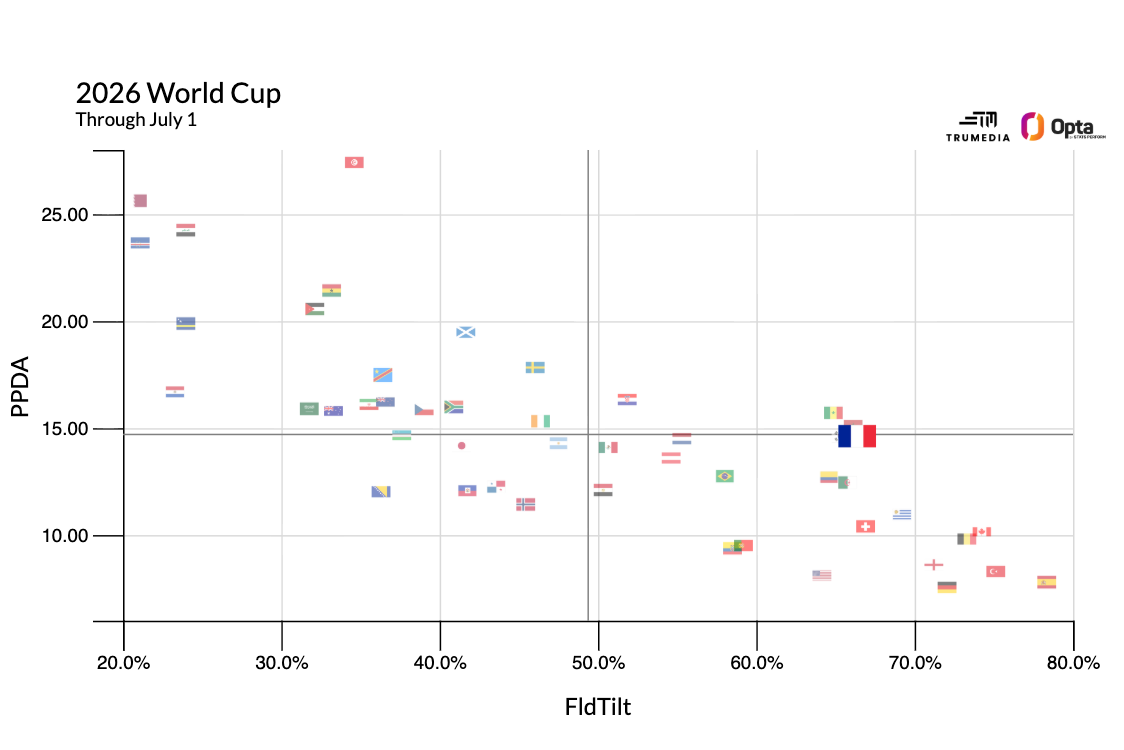
France rank in the top 10 in field tilt, but then they’re slightly below average for how aggressively they press. What’s happening? Part of it is who they’ve played so far: teams unable to really take the game to them in possession. And part of it is that, well, you’ve seen Michael Olise and Mbappe and Dembele play, haven’t you? Why would you ever risk giving them space to run into?
Someone, though, is eventually going to try to starve the supply lines up to the front three. Unfortunately, it’s not going to be Paraguay.
The big question: Can the defense hold up?
2:11
Is Nusa what makes Norway ‘special’?
It’s easy to imagine what Norway would look like under most managers. To oversimplify: They have one gigantic, unstoppable center forward who thrives in space, one savvy attacking midfielder who thrives at playing those passes into space, and a bunch of big dudes who are role players on teams throughout Europe.
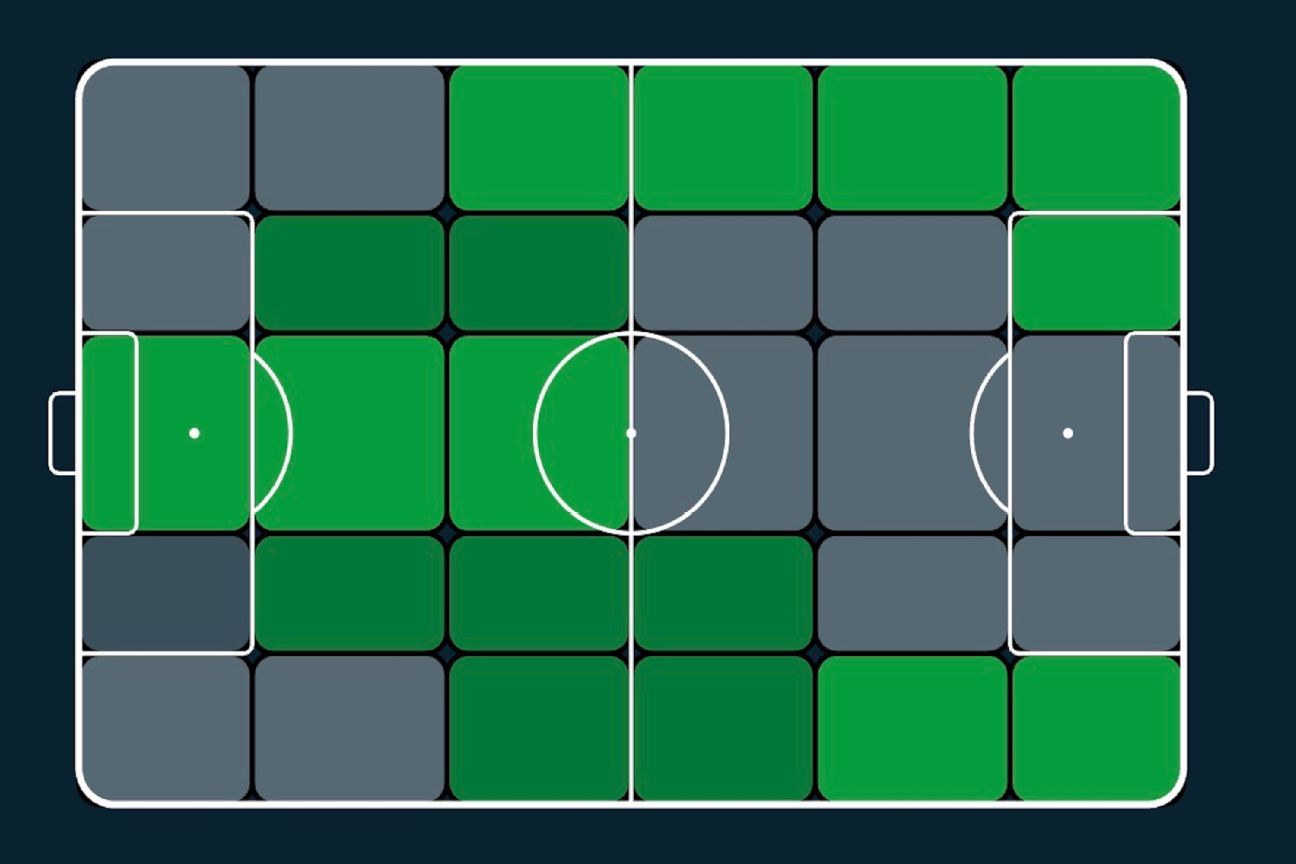
Sit deep, defend, and play on the counter, right? Not quite. Through four matches, they’ve moved the ball upfield at a speed of 1.05 meters per second — just the 39th-fastest among all teams thus far. Instead, they’re kind of a hybrid: They don’t press high, but they also don’t drop too deep. They don’t hunt out possession, but they also protect the ball once it’s back under their control.
You can see it in this field control map from Futi; areas where they have more possession than their opponents are in green:
So why not sit a little deeper and try to earn some more space for Erling Haaland to break into? Well, this team just isn’t good at defending. Despite controlling 50% of the possession in their matches, they’ve 59 shots to the 44 they’ve attempted. Pull out the France game when they played the backups, and they’re still minus-10 on the shot count. They’ve conceded eight goals through four matches, and their 1.4 expected goals conceded ranks 30th among all teams.
Brazil have struggled at times against organized opponents; can Norway provide the same kind of resistance in the round of 16?
 Morocco
The big question: Will they keep this up?
0:33
Morocco fans in Casablanca celebrate last-gasp equalizer vs. Netherlands
Let’s get this out of the way: Yes, that is an incredibly weak “big” question. And sure, fine, whatever: you could say that about any other team, too. The other ones will be better, I promise. But I’m struggling here because Morocco have been excellent in all four matches so far. If Morocco keep playing like they’ve played so far, then Zohran Mamdani is going to be right again: they absolutely can win the World Cup.
I can’t really think of a better are-they-good stress-test than this: Morocco have straight-up outplayed both the Netherlands and Brazil already, producing a 25-to-18 shot margin across those two matches and controlling about two-thirds of the final-third possession.
Pick whatever part of the game you want, and they’ve shown us they can do it: They can build from the back, they can break you down with high possession, they can counterattack at speed, and they held the Dutch to six shots and just 0.24 expected goals across 120 minutes.
The only lingering doubt in my mind, then, is … should these players be this good? This team has lots of top-level talent, but Achraf Hakimi is the only real star on the roster, and he’s a fullback. No one else is a consistent contributor to one of the top club teams in Europe. Bilal El Khannous, Noussair Mazraoui, Ismael Saibari and Azzedine Ounahi have been among the best players in the tournament, but no one would’ve tagged them as such before it started.
International soccer is a different game than what we see in England and Spain every weekend, though. It’s simpler, different spaces appear, and certain skill sets become more valuable.
And sometimes? A collection of players and coaches happen to fit together just so — skill sets amplify, rather than overlap — that they produce something well beyond the sum of their parts.
 Paraguay
The big question: Can they keep scoring first?
There really aren’t any questions about what to expect from Paraguay. They’re an excellent defensive team. They’re not going to try to do anything other than sit back, play on the counter and sneak a goal or two from set plays. If they’re allowed to do that, then well, why don’t you ask Türkiye and Germany about what it’s like to play against them?
1:35
Can Paraguay cause problems in the Round of 16?
Paraguay have made 718 low defensive actions so far — essentially, defensive interventions in their own half — while no other team had made more than 478 through the first four games of the round of 32. That is, in large part, by design.
Of course, you can’t just sit back and counter if you’re losing — as we saw when the Paraguayans got obliterated by the USMNT after conceding an own goal in the seventh minute of their opening match of the tournament. Their low-block defending is good enough to frustrate anyone, but it’s really hard to see them going any further if they ever go behind.
 Brazil
The big question: Uh, what’s the plan here, guys?
While it took until injury time to take the lead over Japan, Brazil were totally dominant in the second half. They took 11 shots to Japan’s one, controlled 80% of the final-third possession and ultimately deserved the victory.
The bigger the circle, the higher the expected-goal value of the attempt:
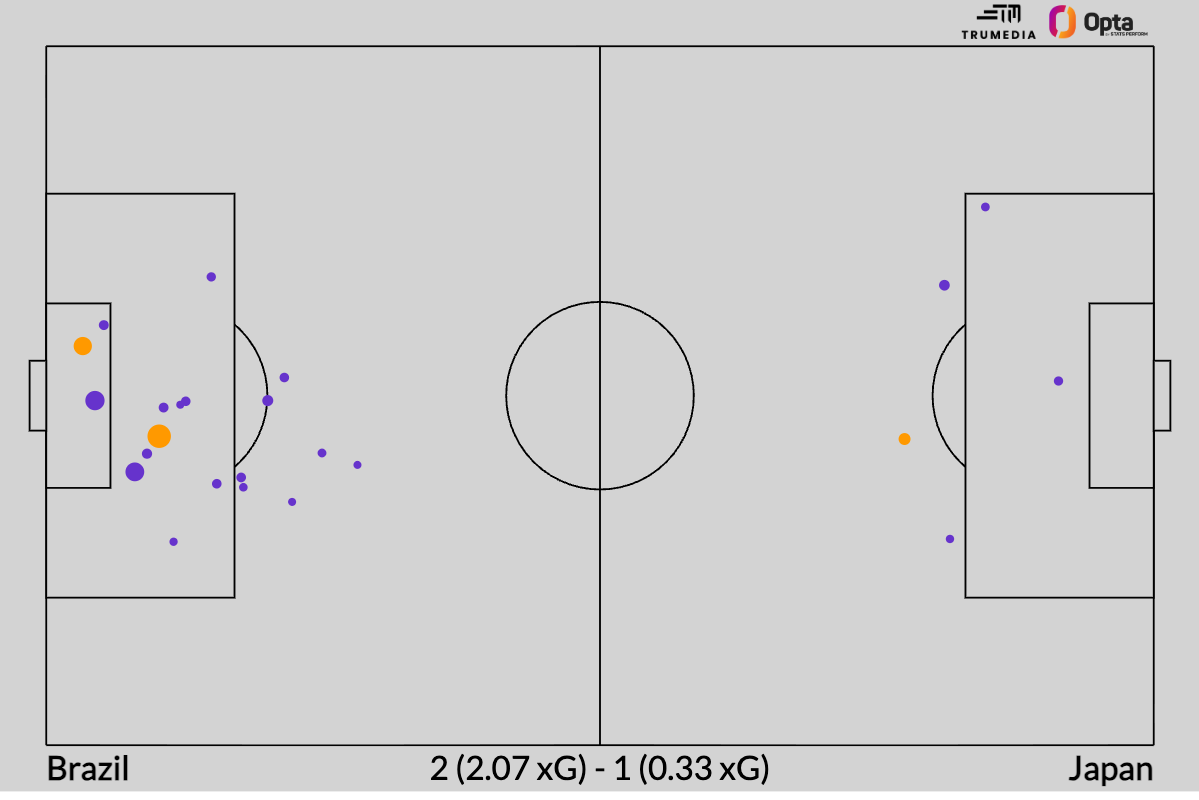
It’s just that … well, there was a first half to the game, too. The collection of chances were roughly even across the first 45 minutes, and Japan went into the breakup 1-0.
So what changed? The Brazilians finally broke free from the system-obsessed tactical shackles created by European club soccer’s global dominance and freestyled their way to a victory.
2:35
Nicol: Brazil have ‘too many problems’ to be contenders
Just kidding: they simply smashed the ball into the box over and over and over again until they broke through. Carlo Ancelotti’s team attempted 40 crosses against Japan, Brazil’s third most ever in a World Cup match since 1960. And 70% of those crosses came in the second half.
In both of their matches against competent, well-coached opposition — Japan, and the opener against Morocco — Brazil struggled badly in the first half before Ancelotti made some subs and the team’s individual talent eventually got something from both games. Japan’s three best players were injured for Monday’s match, and they just ran out of steam in the second half.
But what happens once the Brazilians meet up with an organized side that also has superstar attacking talent? We’re going to find out next round.
 Canada
The big question: Can Alphonso Davies play for more than 20 minutes?
0:59
Hutchison: Canada have to have positive approach to Round of 16 match
From a tactical standpoint, we know exactly what Canada are going to do: play like a team funded by an international energy drink conglomerate.
Most teams fall into one of two camps: press high and control the game with possession or sit back and counterattack. Except for his current Canada, and all of the Red Bull teams Jesse Marsch managed in the past. No, they both press high and play incredibly aggressively as soon as they win the ball back.
As measured by passes allowed per defensive action (PPDA), Canada are one of the 10-most-aggressive pressing teams in the tournament. And yet, they’re also moving the ball upfield at a rate of 1.85 meters per second — by far the fastest rate of any team in the tournament. No one else ranks in the top 10 of both metrics.
And so the ceiling for Canada here is defined by something quite simple: How much will the greatest player in the history of their country actually play? Davies reinjured his hamstring while playing for Bayern Munich in early May, and he’s only featured in 22 total minutes so far this summer. He’s the one Canadian player who can break a game open all by himself.


