


Scientists recreated an ancient Chinese bronze-casting technique with 3D printing; a process that took weeks now takes under 40 hours


Researchers have recreated the logic of an ancient Chinese bronze-casting technique with digital modelling, 3D printing and substitute materials, cutting a process that traditionally takes weeks to less than 40 hours. The study focused on ‘piece-mold casting,’ a distinctive method used to produce ritual bronzes during China’s Shang and Zhou dynasties. Traditionally, reconstructing this process for research can require highly skilled craftspeople, extensive manual work and around one to two months to complete. The new approach was tested on a Shang dynasty-style ‘Ding’(a three-legged bronze vessel). Rather than attempting to replace the original craft, the researchers developed a faster way to test how ancient molds may have been designed and assembled. According to the study titled ‘Integrated digital casting: a new method for simulating piece-mold techniques of ancient bronzes,’ the resulting castings retained important features associated with piece-mold production while making experimental reconstruction more precise and reproducible.
How did 3D printing recreate ancient Chinese bronze-casting techniques
Ancient Chinese ritual bronzes were commonly made using piece-mold casting, a process that differed from the lost-wax technique used in many other ancient civilisations. The method began with a model of the object, around which an outer mould was created and divided into separate sections. An inner core was then placed inside the assembled outer mould, leaving a space between them into which molten metal could be poured. The sectional design of these molds was crucial. The way a vessel was divided determined whether the individual pieces could be removed, reassembled and successfully used for casting.According to the study, researchers have long examined bronze surfaces and excavated mold fragments to understand these ancient production methods. Experimental reconstruction provides another way to test such ideas, but traditional experiments can be difficult to repeat because they depend heavily on individual craftsmanship and environmental conditions. The new method began by creating a digital model of a ‘Shang dynasty Ding.‘ The researchers used modelling software to divide the vessel digitally into separate outer mould sections and an inner core. They also incorporated alignment features to help the different sections fit together accurately. Those digital components were then converted into mold negatives and produced using a 3D printer. This created a standardised starting point for the rest of the experiment.
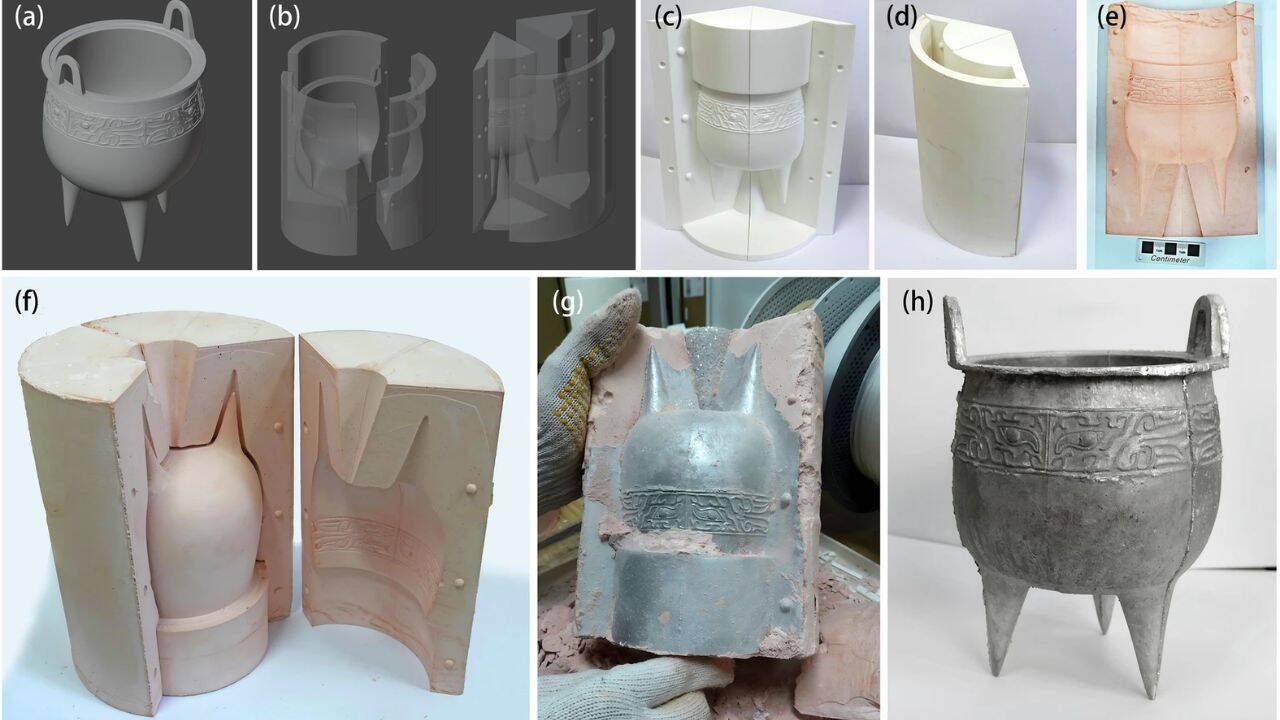
a Modeling the taotie-patterned Ding; b Modeling the outer mold and core for the taotie-patterned Ding; c 3D printing the mold negatives for the Ding; d Assembling the mold negatives; e Gypsum outer mold for the taotie-patterned Ding; f Assembling the gypsum mold for the Ding; g Breaking the mold after pouring; h Finished casting. Image Credit: Nature
Traditional reconstruction was demanding and took almost 2 months of hard work
The researchers also documented a conventional piece-mold casting workflow to understand the practical difficulties involved in reconstructing the technique. Traditional experiments require numerous stages, including making a model, preparing the mould material, shaping and carving its surfaces, drying the mould and, in some cases, firing it before the metal can finally be poured. Small mistakes at different points in the process can cause failure and force the work to begin again. The study found that producing a single mould set could take at least 50 days, even when undertaken by a skilled craftsperson. Drying alone can substantially extend the process, while factors such as temperature and humidity make some stages difficult.The work can also involve demanding technical conditions. Traditional reconstruction may require high firing temperatures and careful control over molten metal, making repeated experiments costly and time-consuming. These obstacles limit how many alternative mold designs researchers can realistically test.
How did substitute materials make bronze-casting experiments faster and easier
Instead of reproducing every material and condition used by ancient craftspeople, the researchers focused on preserving the underlying logic of the piece-mold system. After the 3D-printed negatives were produced, the team poured a low-density gypsum mixture into them to create the physical outer mold sections and core. Gypsum was selected as a substitute for clay because it could set relatively quickly and maintain dimensional accuracy. The mold pieces were then assembled and secured. Once the structure was ready, a low-melting-point alloy was poured into the cavity rather than traditional high-temperature bronze.This approach allowed the researchers to avoid the demanding firing and high-temperature pouring stages required in conventional experiments. The study stresses, however, that the substitute materials were research tools instead of evidence that ancient Chinese craftspeople used the same substances. The method was designed to test hypotheses about mold geometry and assembly, not to replace traditional clay-based reconstruction.
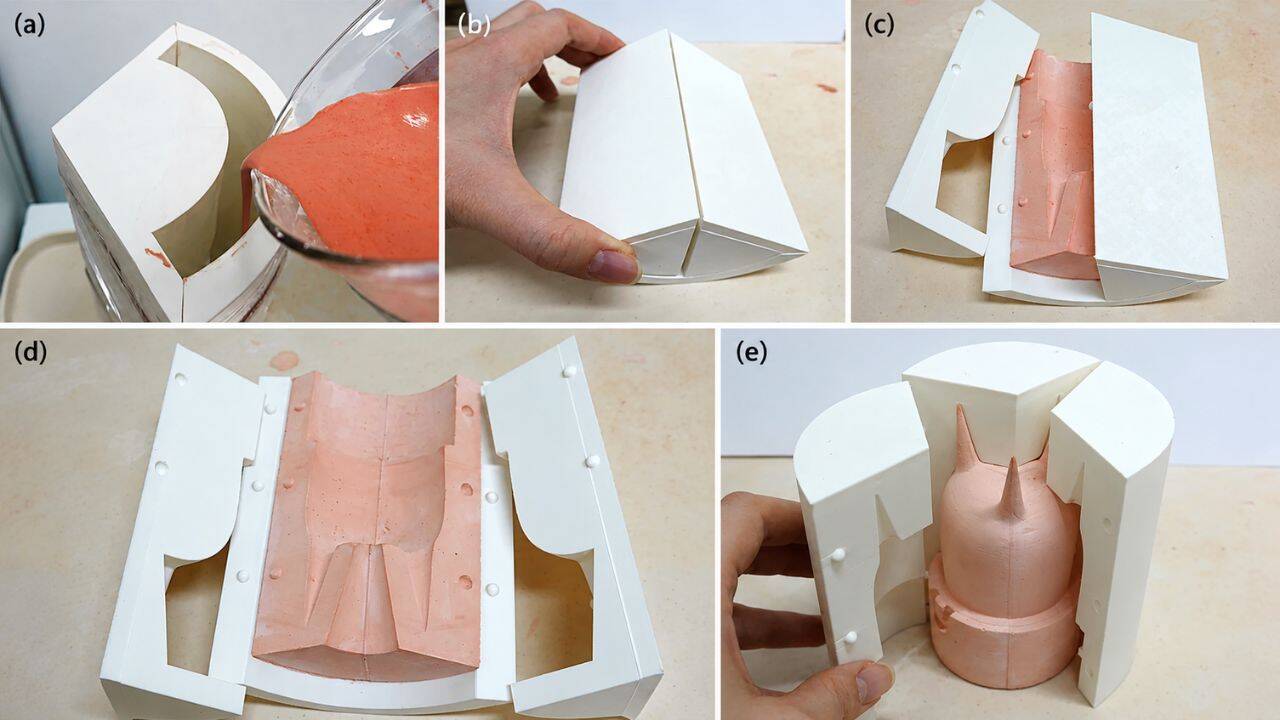
a Pouring the gypsum slurry; b, c, d Removing the outer mold negatives; e Removing the core negatives. Image Credit: Nature
The final castings preserved the marks of the mold-making process
A major question was ‘whether the digitally assisted method could still produce objects that reflected the distinctive characteristics of piece-mold casting.’ According to the study, the resulting Ding retained features such as casting joints and mold marks. These characteristics are important because similar traces on ancient bronzes can provide clues about how their molds were originally arranged. The researchers also compared their digitally produced vessel with an original Shang dynasty-style Ding and a version made through traditional reconstruction. The digital method offered more consistent control over wall thickness and reproduced decorative patterns directly from the digital model.Its mold sections could also be assembled with greater precision, while intentionally designed mold marks remained visible on the finished casting. The study reported improved regularity around the vessel’s rim and more consistent surface details.
What could this mean for the study of ancient craftsmanship
The most dramatic advantage was ‘speed.’ The integrated digital casting process reduced the experimental cycle from several weeks to under 40 hours. That could allow researchers to test different ideas about how ancient molds were divided and assembled without committing months of work to each reconstruction. Digital files also make the process easier to reproduce, allowing experiments to be repeated with more consistent dimensions and parameters. The authors of the study suggest that the method could also have educational value. By lowering the technical barriers involved in reconstructing piece-mold casting, it could help students and museum audiences better understand the principles behind one of ancient China’s most important manufacturing techniques.The researchers do not present the process as a replacement for traditional craftsmanship. Instead, it offers a complementary tool: one that combines modern digital technology with the structural logic of an ancient technique. In doing so, the study provides a faster route for investigating questions that have remained hidden within the seams and surfaces of Chinese bronzes for thousands of years.


