


Utah declares emergency, limits fireworks ahead of July Fourth as crews battle largest U.S. wildfire


Utah restricted fireworks and declared a state of emergency Friday ahead of July Fourth celebrations as the United States’ largest wildfire expanded its reach across more tinder-dry forest, as crews rush to fight new blazes in the arid state.
The National Weather Service issued a rare “Particularly Dangerous Situation” warning as dry, windy conditions provided fuel for more fires across the western U.S.
The Cottonwood Fire in a sparsely populated area of southern Utah started Monday. It ballooned to more than 112 square miles by Friday, burning unchecked as strong winds grounded air support, forestry officials said. One of six large wildfires burning in Utah, it severely damaged the Eagle Point ski resort in Beaver County, forcing mandatory evacuations.
As of Friday evening, Utah had 10 active wildfires burning across more than 144,700 acres, according to the state’s wildfire dashboard. The Cottonwood Fire had burned nearly 72,000 acres and is at 0% containment.
“We have the 35 miles-per-hour sustained winds that they predicted, and we definitely have the 45 miles-per-hour gusts,” said Alyssa Mason, a spokesperson assigned to the fire. “So there has been a great increase in the fire activity. We are seeing extreme fire behavior out there with some crown runs and definitely some spotting.”
Ty ONeil / AP Photo
The smoke has been pushing to the east and northeast, meaning air quality at popular vacation spots like Zion and Bryce Canyon national parks — located far south of the flames — hasn’t been significantly affected beyond some haze in the Bryce area. Still, visitors to Bryce have posted videos on social media showing the giant plume in the distance.
The smoke could be seen for hundreds of miles, all the way to Colorado, as authorities put roughly 1,300 residents in the towns of Marysvale, Junction and Circleville on notice that they should be prepared to leave if conditions worsen and the fire pushes farther.
State forester Jamie Barnes had said Thursday that it’s like nothing seen in recent memory. She said fires are spreading farther and faster “under conditions that defy historical expectations.”
Bruce Brown, 76, accompanied the sheriff on Thursday to find that his cabin and others in the area were gone. He found a burned-out moonscape with power poles tipped over along the canyon.
Alyssa Olsen, 27, said her family’s cabin also burned. It was the last place they gathered for family photos with her grandmother before she died of cancer. Her brother was planning to get married there in two months.
“That stuff you can’t just build back,” Olsen said.
Gov. Spencer Cox set the temporary fireworks restrictions through July 5 as the nation prepares to celebrate its 250th anniversary, saying “this year is different.”
The weather service in Salt Lake City, for the first time in the office’s history, issued a “Particularly Dangerous Situation” warning for five Utah counties, including the area of the Cottonwood Fire. The rare alert was first used to warn of tornado conditions. A red flag warning was also issued for most of the state.
“Prepare now for rapid fire growth,” it said.
A similar “dangerous situation” warning had been issued for the 2025 Palisades Fire in Los Angeles. A federal judge declared a mistrial Friday in the arson case against Jonathan Rinderknecht, the man accused of sparking that fire. The jury said it couldn’t agree on a verdict.
While the Cottonwood Fire’s cause was unknown, Cox’s order noted that humans have been the cause of most fires in the state so far this year. Utah has seen 376 wildfires this year, and 273 of those were caused by humans, according to Utah’s wildfire data.
The governor’s order gives Barnes power to restrict or prohibit fireworks displays in Utah’s cities and towns, instead of leaving those decisions to the communities.
Mike McMillan/U.S. Forest Service via AP 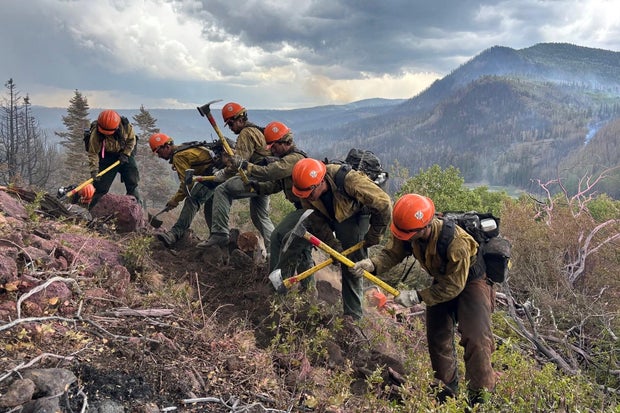
With extreme fire conditions persisting, Rocky Mountain Power issued a public safety power shut-off watch/warning for areas of central, southern and eastern Utah through the weekend.
Crews were also battling the Iron Fire southwest of Salt Lake City. The flames on Thursday forced the temporary evacuation of Eureka, population 1,000.
Red flag warnings, which mean conditions such as low humidity, warm temperatures and strong winds can create an extreme wildfire risk, were in effect Friday and stretched from Idaho to southern Arizona and New Mexico.
The warnings extended into Saturday, with forecasters predicting winds of 25 to 35 miles an hour and very low humidity levels. The worst conditions were expected from northern Arizona into central and southern Utah.
Much of Utah already is experiencing severe to extreme drought, while parts of Colorado, Arizona and New Mexico are experiencing severe drought, according to the U.S. Drought Monitor.
Tim Brown, a research professor and director of the Western Regional Climate Center, said the potential for extreme fire behavior will remain as long as it’s hot, dry and windy.
“I would not be surprised to see a lot of restrictions come out as we get closer to the July Fourth weekend,” he said. “People really need to be aware of their surroundings if they’re going to be out in the forested campground areas and grassland areas.”
Even in Florida, where there have been multiple brush fires, authorities are urging people to skip the personal fireworks and instead leave the pyrotechnics to professionals putting on carefully planned shows.
In Utah, federal land managers have closed public lands near the Cottonwood Fire as a precaution, and in New Mexico, forest officials closed campgrounds and trails near a wildfire burning in the Jemez Mountains.
Nationally, nearly 3 million acres have burned since the start of the year, pushing the U.S. ahead of the 10-year average. The National Interagency Fire Center said firefighters are making progress on containing fires from Alaska to Florida.


