


Doctors thought man had brain cancer — they found live tapeworms instead


Screwworm outbreak threat to US livestock, prompts USDA action
Agriculture Secretary Brooke Rollins discusses USDA’s response to the New World Screwworm outbreak in Texas and New Mexico, assuring safe food supply on ‘The Bottom Line.’ VI LONG DEK: Agriculture Secretary Brooke Rollins addresses the alarming resurgence of New World Screwworm in Texas and New Mexico, emphasizing USDA’s aggressive containment efforts. She confirms the food supply remains safe while highlighting the administration’s focus on domestic fertilizer production, investing billions in new plants and infrastructure projects. Rollins celebrates 250 years of American agriculture and its vital role in national security.
NEWYou can now listen to Fox News articles!
Doctors thought a 60-year-old man had metastatic brain cancer after scans revealed multiple tumors – but further testing revealed a shocking diagnosis.
The Spanish man, who was not named, was found to have a parasitic tapeworm larvae lodged in his brain — a case of neurocysticercosis, a parasitic infection of the central nervous system caused by the pork tapeworm (Taenia solium).
The patient, a lifelong resident of Castellón, Spain, had not traveled to any regions where the disease is endemic, according to the case report published in the CDC journal Emerging Infectious Diseases.
DEADLY ‘FOX TAPEWORM’ LINKED TO LETHAL DISEASE DETECTED IN WEST COAST WILDLIFE
The man had initially come to the hospital after suffering two weeks of progressive headaches and mild behavioral changes.
Radiologic findings from a study of autochthonous neurocysticercosis brain lesions mimicking metastatic disease. (Emerging Infectious Diseases)
CT scans showed multiple abnormal spots that looked like tumors that had spread from cancer elsewhere in the body, leading doctors to suspect advanced brain cancer.
However, whole-body scans, a colonoscopy and specialized imaging failed to identify cancer anywhere in the patient’s body, the case report stated.
NEUROLOGISTS REVEAL THE TOP 3 FOODS TO AVOID TO PROTECT YOUR BRAIN AND NERVOUS SYSTEM
When doctors performed a more detailed MRI, they discovered several fluid-filled cysts in the brain, some of which contained the head of a tapeworm. A blood test confirmed the diagnosis of neurocysticercosis.
The man was treated with a combination of albendazole and praziquantel (two antiparasitic medications), as well as corticosteroids to reduce inflammation. He successfully recovered with no complications, according to the case report.

CT scans (not pictured) showed multiple abnormal spots that looked like tumors that had spread from cancer elsewhere in the body, leading doctors to suspect advanced brain cancer. (iStock)
The authors suggested that the patient may have gotten the infection after accidentally ingesting microscopic tapeworm eggs years earlier.
The exposure may have occurred while working a construction job with migrant coworkers from regions where neurocysticercosis is endemic.
TEST YOURSELF WITH OUR LATEST LIFESTYLE QUIZ
People can catch the pork tapeworm in two different ways. Eating undercooked infected pork usually leads to an intestinal tapeworm, but accidentally swallowing the parasite’s eggs — typically through food or water contaminated with feces — can send the larvae into the bloodstream, where they may form cysts in the brain and other organs. This can cause the disease the patient in the case report acquired.
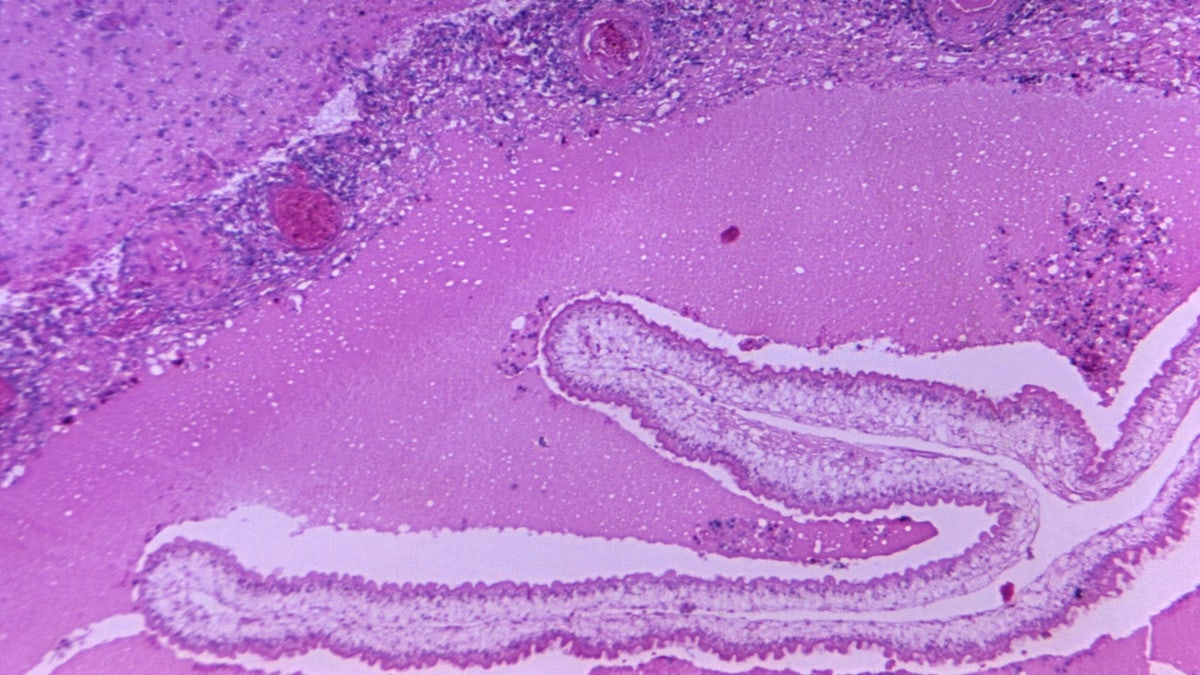
A photomicrograph shows histopathologic features in a brain tissue specimen from a case of neurocysticercosis caused by the pork tapeworm Taenia solium. The image documents pathological changes associated with this parasitic infection. (Smith Collection/Gado/Getty Images)
As this was just a single case, the source of transmission could not be proven, the researchers acknowledged, and the findings cannot be generalized to a wider population. The report shows that there is a possibility of local transmission in non-endemic settings, but cannot establish how often this occurs.
CLICK HERE TO SIGN UP FOR OUR HEALTH NEWSLETTER
In the United States, less than 2% of neurocysticercosis cases are considered domestically acquired, according to the case report.
A prior systematic review identified only 18 confirmed locally acquired cases in Western Europe between 1990 and 2011.

The authors suggested that the patient may have gotten the infection after accidentally ingesting microscopic tapeworm eggs years earlier. (Associated Press)
In some cases, NCC can cause serious symptoms, including seizures, stroke, neurological deficits and cognitive decline.
CLICK HERE FOR MORE HEALTH STORIES
“Our case emphasizes that the absence of travel history should not preclude NCC from the differential diagnosis of multiple ring-enhancing brain lesions, even in regions where metastatic cancer is statistically much more likely,” the researchers concluded in the case study.
CLICK HERE TO DOWNLOAD THE FOX NEWS APP
Detecting the worms earlier could have prevented “unnecessary invasive oncologic procedures and led to prompt, targeted antiparasitic therapy,” they added.
Fox News Digital reached out to the researchers for comment.


