


Jaipur’s Timeless Block Prints, Reimagined By A London Designer Who Found Home In The Pink City


Last Updated:
English florals, reimagined through block printing, move beyond traditional motifs to give the age-old craft a distinctly modern edge.




For nearly four months each year, Jaipur becomes home to Rosanna Falconer, as her work moves between the Pink City and London. (Image: Saurabh Srivastava)
What began as a honeymoon trip soon turned into something far more enduring. London-based textile and interiors designer Rosanna Falconer kept returning to Jaipur with her family, and with each visit, the Pink City began to feel less like a destination and more like a creative anchor. Over time, she found herself drawn not just to its colours and culture, but to something deeply rooted in its everyday life—its centuries-old craft of block printing.
Falconer recalls that during one such visit, when she was travelling with her two-year-old daughter, she found herself painting more than usual. That quiet, personal moment sparked a question—how might her watercolours translate into the language of block printing?
Curiosity soon turned into immersion. She began spending time in local studios, quietly observing the rhythm and precision of the craft. The experience, she says, transformed something within her.
When she produced her first sample, the result was more than she had imagined—her paintings were not just recreated, but elevated through the process. “I was completely hooked,” she says.
Since then, Jaipur has become an integral part of Falconer’s creative and professional life, shaping her work across interior design projects and homeware collections, developed in close collaboration with local artisans.
Inside The Rhythm Of Block Printing
In a city that Rosanna described as a craft and culture capital, block printing is so deeply embedded in everyday life that it can almost go unnoticed.
“Block printing is so embedded in Jaipur that you almost take it for granted,” Falconer says. “What shifted for me was not seeing the craft differently, but finding my own way into it.”
That “way in” came through her own visual language—soft, fluid watercolours inspired by English florals, a departure from the bold, traditional motifs typically associated with block printing.
What she discovered, however, was not limitation but expansion. “Working with artisans, I was struck by how the process could actually enhance that hand-drawn quality rather than limit it,” she explains.
The journey of a single design begins with moodboards—gathering references for colour, tone and feeling—often drawn from nature: the curve of a leaf, the softness of petals.
From there, Falconer sketches by hand, layering watercolours before refining the design digitally. The artwork is then translated into wooden blocks, each element painstakingly carved by hand.
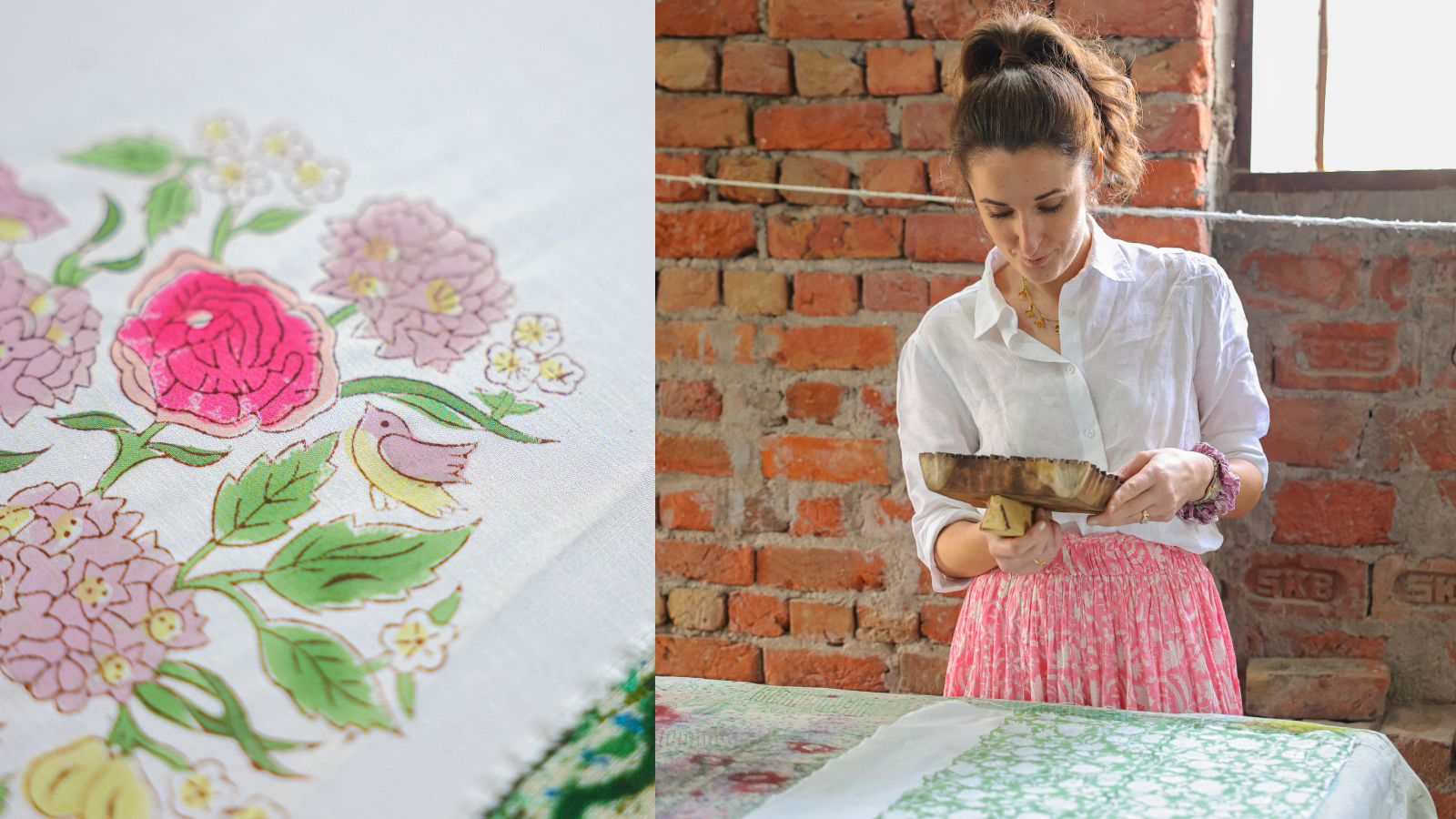
In the studio, sampling becomes a process of trial and refinement—testing colours, adjusting balance—before the design moves into production.
Each piece is printed by hand on cotton, with every colour applied using a separate block. The result is a meticulous, almost meditative process that relies on precision and repetition.
What many outside India don’t realise, she points out, is how deeply this craft is governed by nature itself. “The dyes and prints simply won’t behave properly if there’s moisture in the air,” she says. “Even a hint of rain can bring production to a halt.” In contrast, the intense heat of summer creates ideal conditions, allowing dyes to properly bind to the fabric.
Working closely with artisans has also reshaped her understanding of the craft in more intangible ways. “It’s taught me patience above all,” she says. “It is a process that can’t be rushed.”
“Things often come together at the last minute, but they do come together, and that requires a certain trust in the process.”
It’s a philosophy that mirrors the craft itself, where patience is not optional but essential. There is a deep respect for precision, every placement matters, and an intuitive understanding of colour that comes from generations of practice.
Her role, she believes, is not to disrupt that system but to work within it.
“Block printing has its own rules; if they’re not followed, the print simply won’t work. My drawings are really just the starting point, the match that lights the fire of the artisans’ skill and expertise.”
This delicate balance between tradition and reinterpretation is perhaps what gives her work its distinct voice. It is not about altering an age-old technique, but about allowing it to hold new expressions.
Beyond the studio, that sensibility extends into everyday life.
Bringing Block Prints Into Everyday Life
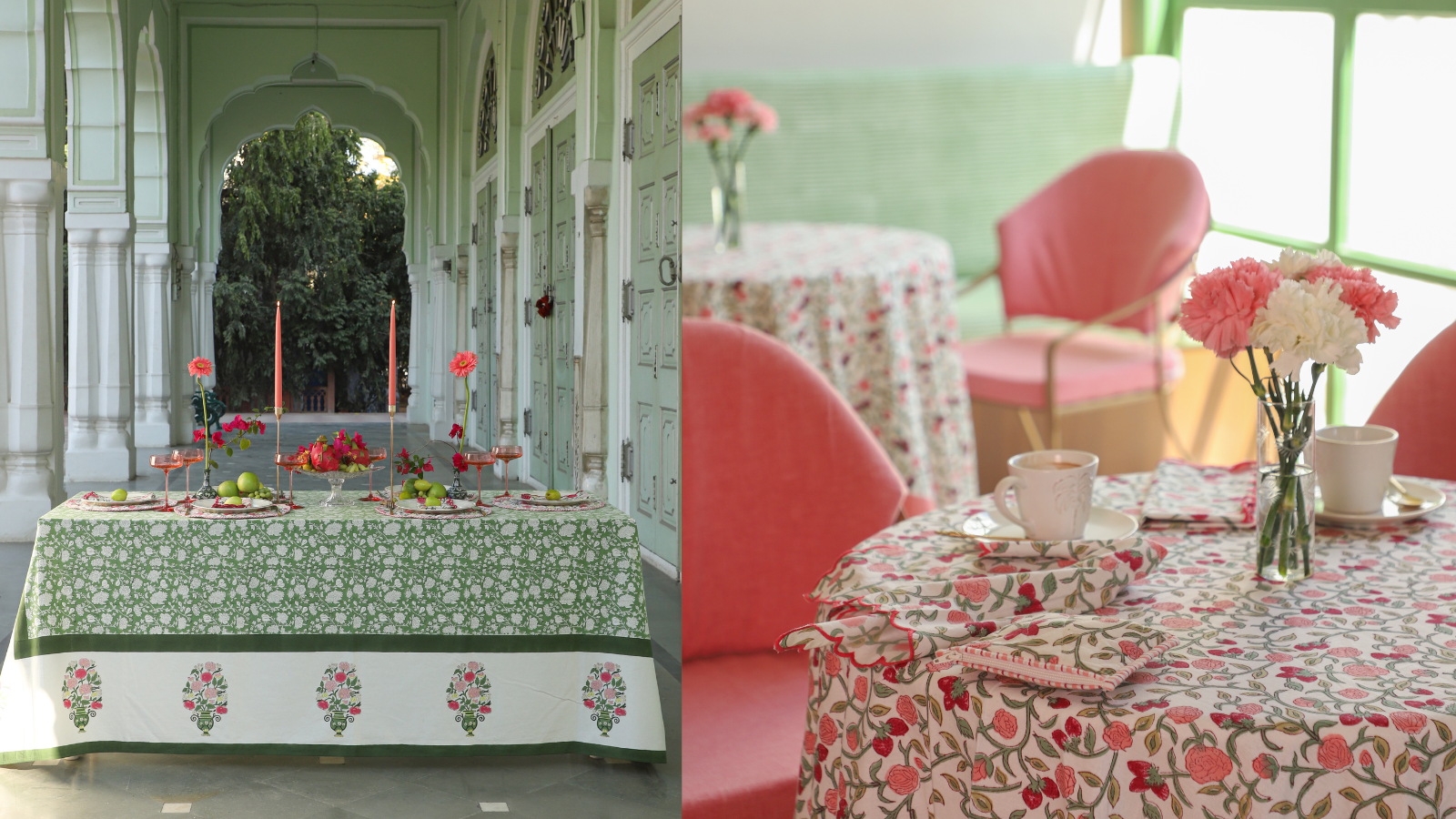
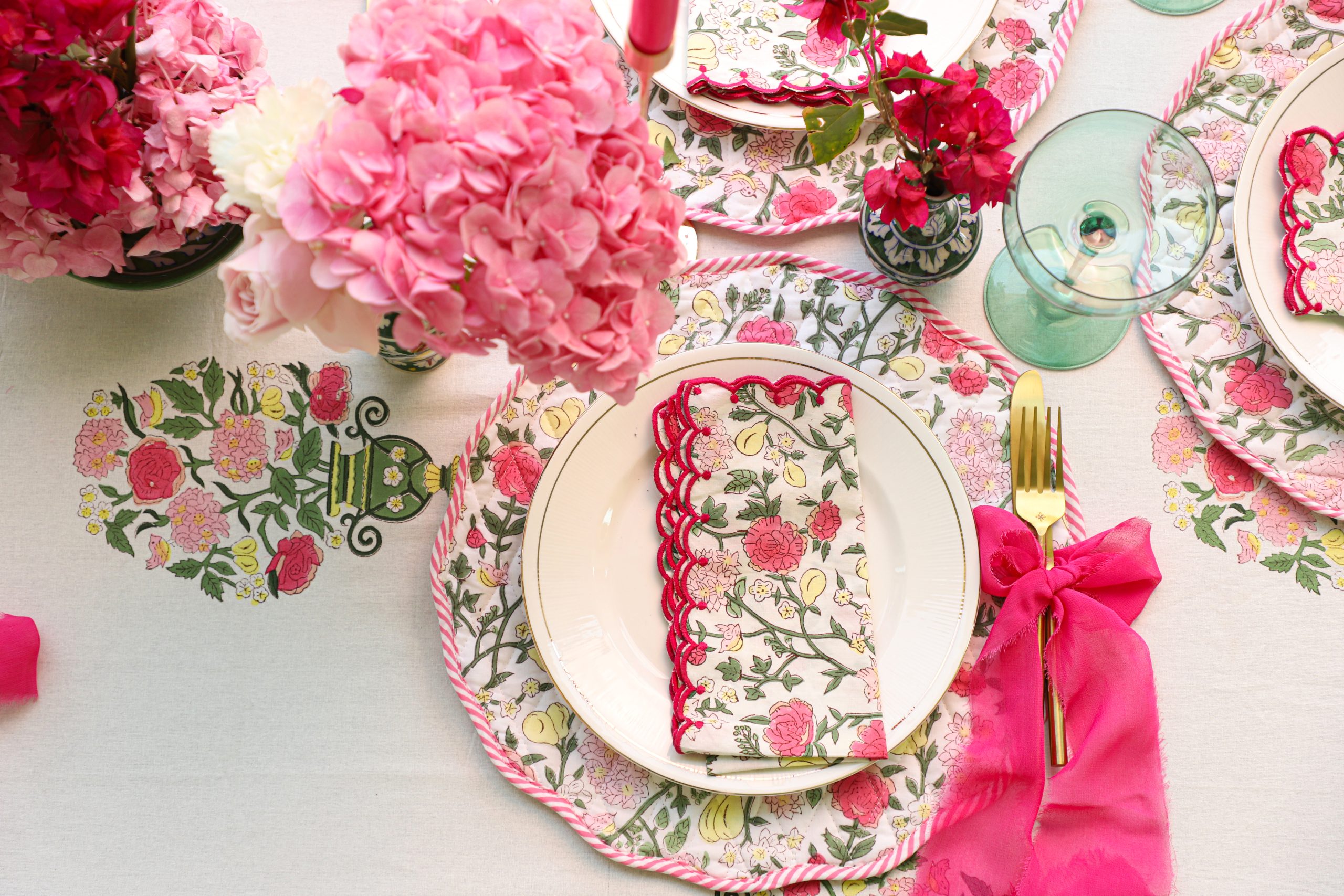
Falconer describes block prints not as decorative objects but as “moments of joy” that bring a space together. A floral quilt layered over crisp white linens, a striped lampshade, or a set of cushions—each element adds a touch of whimsy without overwhelming the room.
“A tablecloth is probably the easiest way to transform a space,” she notes, pointing to the quiet power of these textiles in both kitchens and dining rooms.
For those new to block prints, her advice is simple: start small, or balance bold patterns with neutral tones. “My uniform, both in London and Jaipur, is a white shirt with a block-printed skirt,” she says. “Or you can begin with just a touch—a scrunchie or a small bag. You’ll be hooked before you know it.”
But with that growing global appeal comes a need for deeper awareness. Handcrafted textiles, she emphasises, require a more considered approach. Variations in print and colour are not flaws but markers of authenticity.
Care, too, is key—gentle washing, avoiding harsh detergents, and allowing fabrics to air dry can extend their life significantly. More importantly, she adds, it’s about valuing the process itself. “These textiles are made slowly and by hand—they’re designed to be used, cared for, and enjoyed over many years, rather than treated as something disposable.”
Where Belonging Takes Shape
Today, Rosanna’s time is split between London and Jaipur, with nearly four months of the year spent in the Pink City—though that rhythm shifts with commissions and production cycles.
Home, in Jaipur, is a quiet counterpoint to the sensory overload of the city. She rents an apartment in a leafy neighbourhood, where the sounds of parakeets and peacocks filter through open windows.
The interiors are minimal and white; “a welcome contrast,” she says, “to the colour and intensity of the old city and long days in the studio.”
Living between two worlds, London and Jaipur, has ultimately reshaped not just her creative practice, but her understanding of belonging.
“It’s much less about place and much more about people,” she reflects. Whether it’s her family travelling with her or the friendships she has built in Jaipur, it is these connections that ground her.
And perhaps that is where the story of Jaipur’s block printing finds its most contemporary meaning—not just as a craft preserved in time, but as one that continues to evolve through those who choose to engage with it, patiently, respectfully, and with a sense of wonder.
April 26, 2026, 18:55 IST


