


6G is coming: 100x faster than 5G with mind-blowing AI powers – Here’s what you need to know


What is 6G: Every decade or so, the telecommunications industry jumps to a new wireless generation, the next “G.” 5G landed in 2019. You might have noticed we don’t have robot surgeons or streets full of self-driving cars yet, even though 5G was supposed to make that normal. So, what can 6G do that 5G couldn’t? Why should you care about 6G networks? Here’s what you need to know about how 6G could change technology, AI, and everyday life.
“The networks of today simply aren’t ready for the use cases of tomorrow,” says NVIDIA’s Telecom SVP, Ronnie Vasishta. “In the AI era, everything changes. Networks will deliver intelligence, not just for humans on their phones, but for machines.”
What is 6G?
Expected to arrive around 2030, 6G promises to go far beyond faster downloads. It aims to create a truly intelligent, always-connected world where the physical and digital realms blend seamlessly. While 5G has transformed how we stream, work, and connect devices, experts say it is beginning to hit its limits.
That’s where 6G comes in. Often described as an “AI-native” network, 6G will not only move data at astonishing speeds but will also think, sense, and adapt on its own. 6G (Sixth Generation) is the upcoming wireless standard that will utilize the Terahertz (THz) frequency band (95 GHz to 3 THz) while 5G was about connecting everything, 6G is about intelligent connectivity.
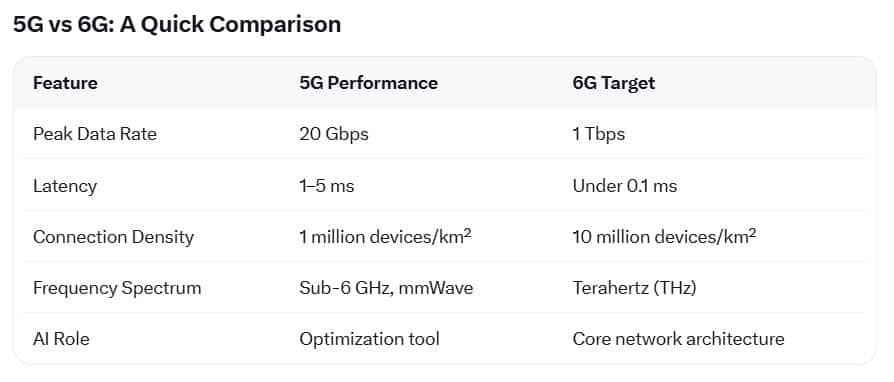
It is expected to offer a theoretical peak data rate of 1 Terabit per second (1 Tbps) roughly 50 to 100 times faster than 5G beyond speed, 6G focuses on Integrated Sensing and Communication (ISAC). The 6G technology network does not send the data but also “sees” and “senses” the physical environment, creating a seamless bridge between the physical and digital worlds.
Its three main pillars include:
Enhanced Mobile Broadband (eMBB): Delivering much faster speeds for streaming, gaming, and large file downloads.
Ultra-Reliable Low-Latency Communication (URLLC): Enabling real-time control for self-driving cars and industrial robots.
Massive Machine-Type Communications (mMTC): Supporting up to one million connected devices in a single square kilometre.
Thanks to 5G, we now enjoy smoother 4K and 8K streaming and the early foundations of smart cities. However, as demand for data grows rapidly, 5G is starting to reach its technical boundaries in terms of speed, capacity, and built-in intelligence.
ALSO READ | OpenAI’s ChatGPT becomes second most downloaded app in world, AI boom surges
Key Features of 6G
Several groundbreaking capabilities are expected to define 6G:
1. Terahertz Frequencies: These ultra-high frequencies will provide enormous bandwidth for massive data transfers.
2. AI-Native Design: Artificial intelligence will be built into the network from the ground up, enabling self-optimization, automatic problem-solving, and smarter resource management.
3. Ultra-Low Latency: 6G aims to reduce delays to between 10 and 100 microseconds, far below 5G’s 1–5 milliseconds.
4. Global Coverage: By integrating with Low Earth Orbit (LEO) satellites, 6G could bring reliable high-speed connectivity to remote areas, oceans, mountains, and even the skies.
5. Energy Efficiency: The technology will support “zero-energy” devices that can harvest power from radio waves or ambient sources, reducing battery dependency.
How 6G Redefines Speed, Latency, and AI
The real revolution lies in three major improvements:
1. Speed
While 5G can reach peak speeds of around 20 Gbps, 6G targets 1 Tbps. To put that into perspective, you could theoretically download over 140 hours of high-definition video in just one second. This level of speed will make real-time holographic calls, immersive virtual meetings, and advanced telehealth services feel completely natural.
2. Latency
6G is expected to bring latency down to under 0.1 milliseconds. This near-instant response will power the “Tactile Internet,” allowing surgeons to perform remote operations with robotic systems as if they were physically present, feeling every detail in real time.
3. AI Integration
Unlike 5G, where AI is mainly used as a supporting tool, 6G will be AI-native. Intelligence will be embedded throughout the network and at the edge. This enables smarter data handling, such as “semantic communication,” where the network understands context and sends only essential information instead of raw data. It will also support highly accurate digital twins, real-time virtual replicas of cities, factories, or even entire power grids.
What Comes Next?
By 2030, 6G is expected to serve as the foundation for autonomous drone delivery fleets, fully immersive metaverses, and intelligent energy systems that can help address global challenges more efficiently. While it’s still in the early research phase, 6G represents more than just a faster network, it signals a fundamental shift toward a world where connectivity is not only seamless but also deeply intelligent.
ALSO READ | Cyber War Boom: How US-Israel-Iran tensions are driving IT services growth
(This article is intended for your general information only. Zee News does not vouch for its accuracy or reliability.)


