


A week out from the U.S. men’s national team roster announcement for the World Cup, it seems we mostly know what head coach Mauricio Pochettino is going to do.
Some questions do linger: Who will be the third goalkeeper? The fourth center back? The fifth central midfielder? The fourth attacking midfielder? Maybe the backup right back?
But those are relatively minor questions, and even some of them might not be as open as they seem. After two years of constant roster flux, a mostly healthy player pool has things fairly settled.
However, what is the overall state of the American player pool heading into the tournament? Are the players heading into the World Cup in good form? Should Pochettino reconsider who his go-to guys are?
We’ve been trying to figure that out with ESPN’s USMNT Player Performance Index for a couple of years now — we use a simple formula looking at how often everyone is playing for their club teams and how good those club teams actually are.
So with the European season nearly fully completed and MLS at least a couple months in, let’s try to rank the top 50 Americans one last time before we find out who will represent the U.S. at the World Cup.
– USMNT depth chart: Top 15 players in each position
– USMNT’s World Cup weakness: Goalkeeper?
– xDAWG: Who in the USMNT ‘has that dog in them’?
How the USMNT PPI ranking works
For the uninitiated, this is a simple rating system based around three inputs: talent, playing time and team quality. As I wrote about last time, here’s how those factors are represented:
Talent comes from Transfermarkt’s estimated market value for every player, the best and most straight-forward measure available. Playing time is the percentage of available minutes each player has played for his team in its domestic league. And team quality comes from Opta’s power rankings, which rate every professional club team in the world and offer a uniform way of assessing the quality of every U.S. player’s club team.
The rankings work off a simple premise: If you’re playing a lot of minutes and your team has a high rating, then you’re likely contributing valuable performance to your team.
That premise doesn’t always hold — hence the talent variable. But at this point in the season, we’re only portioning a small amount of the equation to talent. Only 4% of the rating comes from the player’s estimated market value, while 78% comes from team quality and the final 18% comes from playing time.
In every other edition of this, we’ve excluded injured players. But since this is essentially a full-season look back for the Europe-based players, we’ve included everyone. Injured players may have missed out because they didn’t play enough minutes, but others have played enough for quality teams that they’ve still made the list.
Let’s get to the list.

1. Tyler Adams, midfielder, AFC Bournemouth
This seems strange, no? Adams has been injured on and off for much of the season. He has played a little less than half of the available minutes for a team that has spent most of the season hunkered down in the upper-mid-table of the Premier League.
But if Bournemouth win their next match, they’ll be just one point back of Liverpool for the fifth and final Champions League spot with one game left in the season. Granted, their next match is against Manchester City, but still: Opta rates the Cherries as the 11th-best team in the world. They’re the highest-rated club team for any American who actually plays significant minutes.
The concern, if there even is any, is that Adams has been injured twice in the second half of the season, and Bournemouth’s late-season run has mostly coincided with him either on the bench or coming on as a second-half sub. At least Adams is heading into the World Cup healthy — U.S. fans may knock on wood now.
The fact that Adams landed No. 1 speaks to the power of the Premier League and the state of the U.S. player pool; there are a lot of players having good seasons for good teams, but no one really hitting their absolute peak.

2. Weston McKennie, attacking midfielder, Juventus
That is, other than this guy. In his sixth season with Juventus, McKennie has set career highs in starts and has broken the double-digit goal+assist mark for the first time, too.
I feel pretty confident that McKennie could do exactly what he’s doing for a better team. His ability to impact games without touching the ball a ton really does seem like it scales up. But Juve are still in a battle to qualify for the Champions League next season, and they were knocked out of this season’s competition by Galatasaray.
In my subjective USMNT PPI, McKennie would be No. 1 because he might be the only American in Europe who’s currently having the best season of his career. But according to our rating formula, he falls to No. 2.
2:58
Is Weston McKennie USMNT’s most important player?
The ‘Futbol Americas’ crew debate who is USMNT’s most important player going into the 2026 FIFA World Cup.

3. Malik Tillman, attacking midfielder, Bayer Leverkusen
It has been a successful season … I think? He started slightly more than half of the games for Leverkusen, and although they finished in sixth, they had the third-best expected goal differential in the Bundesliga. This is a good team, and Tillman was on the field more often than not.
As for what he did when he was out there, here are Gradient‘s grades for his Bundesliga play:
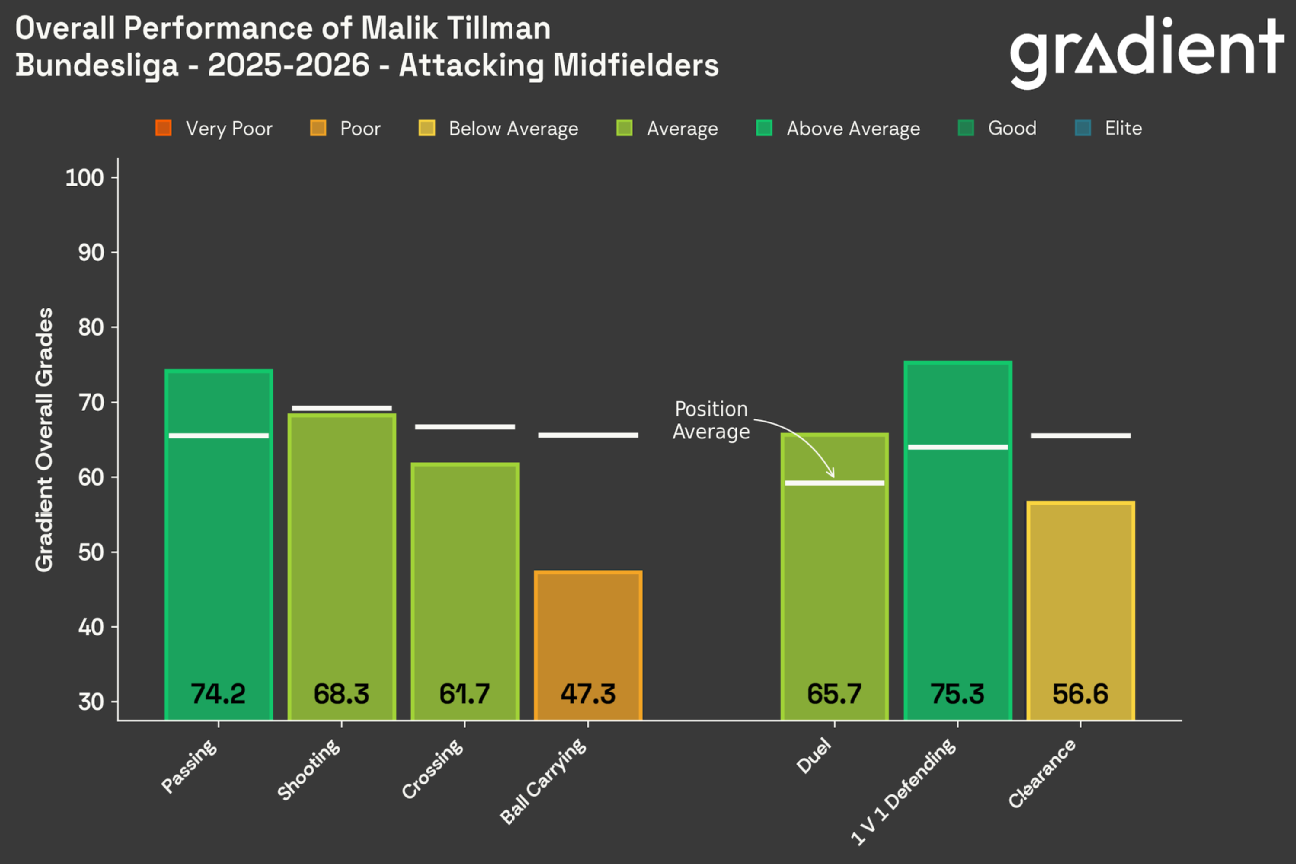
This tracks with his USMNT performances, too. He can make a creative impact on matches, but he’s a very good defensive attacking midfielder.
It’s sort of confusing because he has that kind of languid athleticism that makes it seem like he’s not trying that hard on the offensive end and that he should be influencing games more, but he really does work very hard on the defensive end. This summer, he can fill in the gaps for other U.S. players to make the decisive plays.

4. Chris Richards, center back, Crystal Palace
Richards is the other guy I’d have up toward the top with McKennie. His fall from No. 1 in our December edition and February edition of the USMNT PPI has less to do with him playing poorly and more to do with the limitations of this player-rating approach. Palace lost Marc Guehi to Manchester City in January, so that has affected their performances in a way that says very little about how well Richards is playing.
Well, it tells us something: Richards hasn’t been able to fill the buildup passing void left by his fellow center back.
But also, Palace have still been pretty good over the past few months; the main difference between them and, say, Bournemouth is twofold: (1) chance-conversion luck; (2) Palace have made it to the Conference League finals, and they’ve been rotating their squad because of that, so they’ve lost games that they didn’t care about winning, and that hurt their Opta rating.
OK, we’re too far in the weeds now. Simply put: Richards is a play-every-minute starter when healthy for a good Premier League team. He’ll be the same for the U.S. this summer.

5. Brenden Aaronson, attacking midfielder, Leeds United
Aaronson has played pretty much the exact same number of minutes as he did the last time Leeds were in the Premier League. But this time around, Leeds haven’t fired multiple coaches and doomed themselves to relegation.
On top of that, Aaronson is actually contributing on the offensive end. In his first Premier League season, he pressed like mad — and that was it. He’s still one of the better pressers around, and now he has increased his number of goals+assists from four to nine.
He’s good enough to play in the Premier League, and it wasn’t clear that would ever be true four years ago.
1:41
Brendon Aaronson: USMNT ready for pressure of the World Cup
Leeds United and USMNT player Brenden Aaronson says the USA is ready to face the pressure of being a host nation going into the 2026 World Cup.

The goal drought is not a problem — it’s just trivia. Pulisic’s expected goal and expected assists numbers, per 90 minutes, are the highest they’ve been in any season since he came to Italy. He’s getting and creating the kind of chances that will eventually lead to a lot of goals.
The actual problem — and why he’s not at the top of this list — is that he hasn’t played all that much. He has played less than half of the minutes after breaking 70% in his first two years in Italy.
When he has played this year, I genuinely think he has played better than at almost any other point in his career. And because he hasn’t played as much as in years past, AC Milan are in a battle for Champions League qualification rather than on the fringes of a title race.

7. Johnny Cardoso, midfielder, Atlético Madrid
It’s a similar story to Tillman: a solid if unspectacular season for a new club. He eventually became a starter for a Champions League semifinalist, but only played about one-fifth of the minutes in LaLiga. He wins possession a ton, and he’s just good enough on the ball.
The question going forward is: Can he develop some more passing or just general ball-progressing chops? It seemed like he was on the verge of deservedly reintegrating himself into Pochettino’s plans, and any late-season injury in a World Cup year is a massive bummer.
But as for its effects on the USMNT’s hopes this summer, the guy at the top of this list already does all of the things that Cardoso does.

A former mainstay at the top of this list, his “struggles” are the same as Pulisic’s: he has been injured. That’s the main explanation for his drop from 10 assists last season to zero this season. His expected assist rate isn’t too different from this season, so he’s still putting the ball into dangerous areas quite often.
I wouldn’t have thought this four years ago, but Robinson has also become an important on-ball player for Fulham. In the past, most of his value came from the runs he made off the ball and how he was an outlet for defense-splitting passes, but now he’s moving the ball forward quite often with his passing and dribbling.
It’s not a perfect fit, but it no longer seems like it would be a waste to play him on the outside of a back three, if Pochettino opts for that formation this summer.

Back from an ACL injury, he’s pretty much the same guy you remember: assisting goals once every five games or so, driving possession from deep, and playing every important minute for the most dominant team in the Eredivisie.
He’s sort of a symbol for the state of the top tier of the player pool: a talented player in the middle of a fine season that might not match the high end of his talent. That doesn’t mean he won’t reach it this summer, though.

If you were going to create a striker who will absolutely help the U.S. win games but will frustrate the large portion of the fanbase that doesn’t actually understand how soccer works, it would look exactly like Balogun.
The most important skill for any striker is the ability to get good shots — both with your off-ball movement and your ability to create space for yourself while the ball is at your feet in the most crowded area of the field. Balogun is the best American player ever at both of those things.
Only two players in France have generated more expected goals (xG) this season:
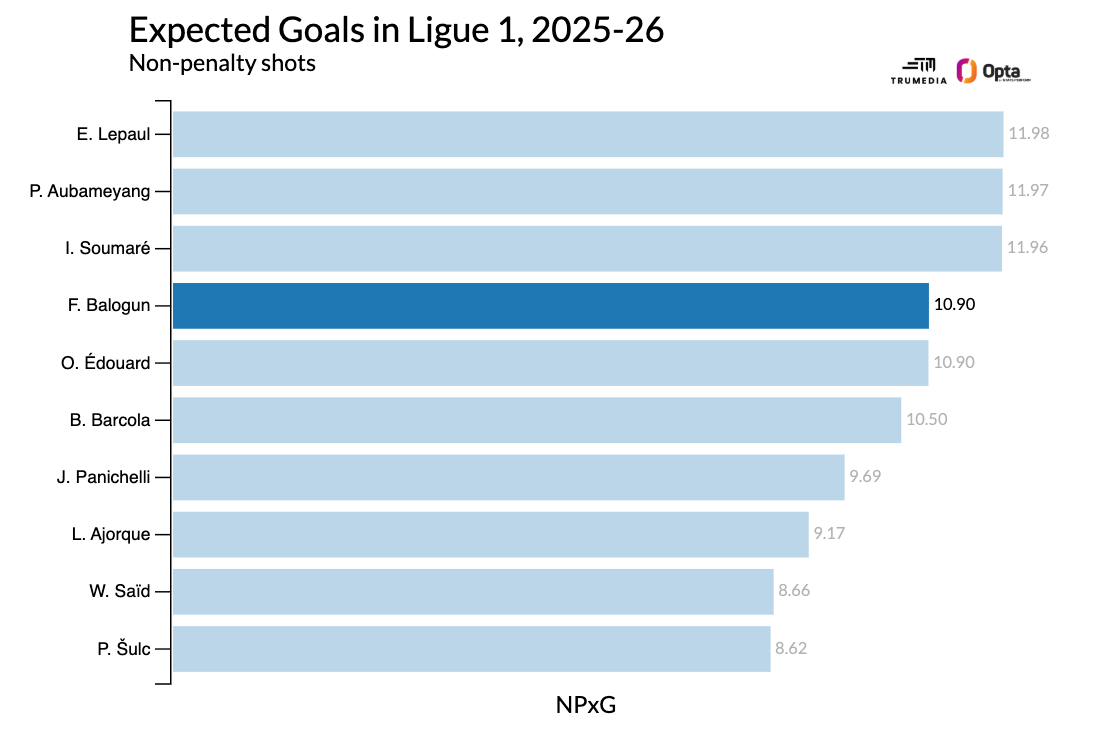
The main “problem” is that he converts those chances at only an average level, which means he scores more goals than most but also misses more chances than the average striker.
Don’t be surprised if your least favorite radio host or TV personality swoops into the action this summer and confidently declares that the U.S. needs a new striker who knows how to finish his chances. Please ignore them.

11. Tanner Tessmann, midfielder, Olympique Lyonnais
0:50
Pepi: World Cup blows Super Bowl and NBA finals out the water
Ahead of the FIFA World Cup in his home country, USMNT player Ricardo Pepi tsays “it is going to be one of the biggest ones ever.”

13. Timothy Weah, winger/fullback/wing back, Olympique Marseille
Here’s Weah’s minutes share, by position, in Ligue 1 this season, per Stats Perform:
– Right midfield: 974
– Right back: 703
– Left attacking midfield: 291
– Right wing back: 135
– Left back: 72
The main takeaway here is that he has barely played his theoretical favorite position: winger, on either side. Weah, whose game isn’t particularly subtle, never really struck me as a jack-of-all-trades guy, but he has been that for Marseille this season, and it seems like Pochettino views him this way, too.

14. Yunus Musah, midfielder, Atalanta

15. Alex Freeman, right back, Villarreal

16. Haji Wright, forward, Coventry City

17. Mark McKenzie, center back, Toulouse
While the top-level stars haven’t maximized their potential, I think it’s worth U.S. fans taking a step back for a second and realizing what this list so far suggests: There are at least 17 American soccer players who play tons of minutes for teams in Europe’s Big Five leagues or more limited minutes for teams in the Champions League. We’ve come a long way since 1994!

18. Andrew Thomas, goalkeeper, Seattle Sounders
This is far from the be-all-end-all for goalkeeper performance, especially in such a young MLS season. But here’s how all of the starting American keepers in MLS have fared by how many goals they’ve conceded relative to what we’d expect the average keeper to concede based on the quality and quantity of the shots they’ve faced:
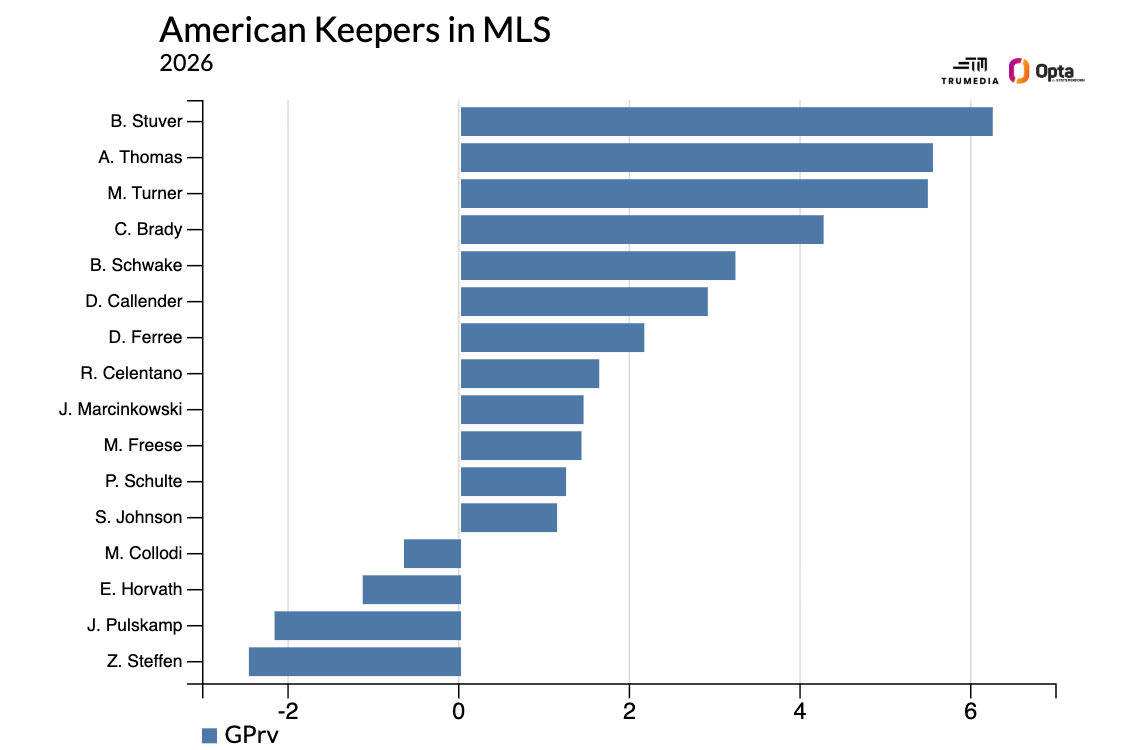
I’m lumping all of the keepers in here because, especially in the somewhat spending-constrained rosters of MLS, they can get stuck on bad teams whose poor performance will ding them in this exercise. Case in point: Matt Freese, the expected starter for the U.S. at the World Cup, is not in the top 50.
But Thomas has been lights-out this season — as has been the U.S.’s presumed backup goalkeeper, Matt Turner.
19. Jackson Ragen, center back, Seattle Sounders

20. Joe Scally, right back, Borussia Mönchengladbach
21. Cristian Roldan, midfielder, Seattle Sounders
What’s with all the Sounders? For one, they have a bunch of Americans who play significant minutes. And two, Seattle and Inter Miami are the two highest-rated MLS teams because of how they each held their own in the Club World Cup this summer.
Roldan is the poster child for this idiosyncratic exercise. He’s the kind of player who might not pop through top-level stats or just from watching a game, but he plays a lot of minutes for teams that win lots of games. And we have enough years of information at this point to confidently say that, yeah, those teams are winning lots of games because Roldan is playing lots of minutes.
22. Paul Rothrock, attacking midfielder, Seattle Sounders

23. Noahkai Banks, center back, Augsburg
If you’re a U.S. fan trying to cope with Banks not committing his future to your favorite team, then, well, I’d probably reexamine your priorities in life. But after that, it may help you fall asleep at night if you reminded yourself that this 19-year-old that you’ve never met hasn’t started a game for Augsburg since the end of March.
24. Jesús Ferreira, forward, Seattle Sounders

25. Aidan Morris, midfielder, Middlesbrough
27. Snyder Brunell, midfielder, Seattle Sounders

28. Lennard Maloney, central midfielder, Mainz 05

29. Brian White, forward, Vancouver Whitecaps
30. Tristan Blackmon, center back, Vancouver Whitecaps
The Whitecaps are looking like they might be one of the all-time great MLS teams, and these three guys above have all played 88% or more of the minutes this season.
(And of course: In a league where the commissioner sounds increasingly like a tech CEO who couldn’t tell you how much a loaf of bread costs, they’re considering moving the team to another city.)



Allow me to belabor the point once more: None of the USMNT’s stars are peaking right now. Even McKennie and Richards, being starters for top-30 teams in the world, probably still haven’t reached the top tier of the potential outcomes we saw for them when they moved to Europe as teenagers.
But the depth is so, so, so much better than it has ever been. Case in point: One of the starting center backs for a league-winning Celtic side might be the last center back on the World Cup roster — if he makes it at all.

36. Tate Johnson, fullback, Vancouver Whitecaps

37. Brian Schwake, goalkeeper, Nashville SC
0:10
Brian Schwake makes a great save
Brian Schwake makes a great save

39. Matko Miljevic, midfielder, Racing Club

42. Daniel Lovitz, left back, Nashville SC
43. Giovanni Reyna, attacking midfielder, Borussia Mönchengladbach
At least he played? Sort of? A little bit?
Reyna played 520 minutes for a bad Gladbach side. And while he still showed some of his on-ball creativity, well, he was trusted to play only those 520 minutes for a team that needed all of the help it could get. On top of that, Reyna attempted seven total shots across the entire Bundesliga season — and three of them came in the first game of the campaign.
There’s a reasonable case to be made for his passing skill to be included on the U.S. roster, though. None of the other attackers offer the same kind of on-ball creativity in the final third that Reyna does, so why not have him in the team so he can come on whenever you’re chasing a game?
Obviously, there have been some, um, issues with him going to a World Cup and not playing much in the past. But when you’re choosing one of the final guys on the roster, I do think it makes strategic sense to bring a flawed, enigmatic player with one very specific and valuable skill over a bunch of more well-rounded players who have had much more successful seasons — and careers — than Reyna.
Somehow, he won’t even be in his prime until the next World Cup.

44. Drake Callender, goalkeeper, Minnesota United
0:11
Drake Callender makes a great save
Drake Callender makes a great save

45. Daniel Munie, center back, San Jose Earthquakes
46. Reid Roberts, center back, San Jose Earthquakes

47. Patrick Schulte, goalkeeper, Columbus Crew

48. Marco Farfan, left back, Tigres UANL
49. Sean Zawadzki, center back or midfielder, Columbus Crew
Zawadzki has an outside shot at nabbing one of the final roster spots, but there are a couple of other MLS players who missed the top 50 but are in contention for a slot, too.
Here are the top 10 Americans in MLS for expected possession value added from open play (how much your actions on the ball increase your team’s chances of scoring):
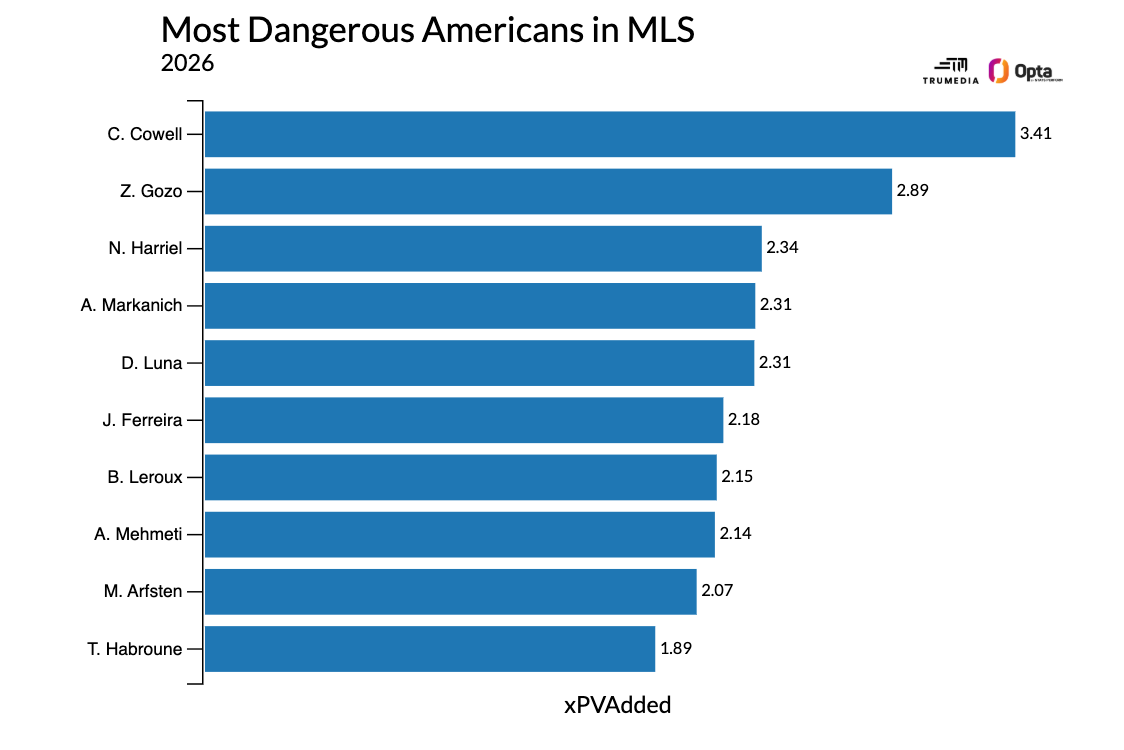
Zavier Gozo is doing this at 19, and he’s outshining his own teammate and USMNTer Diego Luna.
Meanwhile, Adri Mehmeti is 17, and he’s more of a traditional center midfielder, which makes his appearance here even more impressive. And then there’s Max Arfsten, who is technically a defender and will almost definitely be on the roster and could start a couple of games.
The current pool already has more depth than ever before, and now there’s a bumper crop of super-talented teenagers coming up behind them.


